I first published this poem in 2012, remembering a sail into New York Harbor only days after September 11, 2001—the altered skyline, the smoke upon the water, and the journey back toward home.
New York Harbor, One September
… a September memory, 2001
September comes
with its whimsical wind,
and the bittern’s barbaric yawp
echoes across the creek,
a snowfall of seagulls perch
upon the jetty,
watch
as we hoist our sails
at the mouth of the bay —
the sloop floats like paper
blown
by a little boy’s breath,
past inlet coves and marinas:
we reach the Harbor,
the sun’s golden glint turns to rust,
the air is clothed
with subtle shrouds of grey
for weeping —
far off into the distance the skyline
is a ghastly dream,
toothless
of two towers,
and the salt air mingles with smoke
and burning steel,
ashened mortar,
the putrescence
of flesh and flowers —
we turn around,
maneuver the wind,
the charts and tides,
to reach our own secluded harbor,
cradled by the arms of moonlight—
we throw down the anchor,
fall asleep under a cupola
of infinite constellations.
a stillness, a widow’s veil enshrouds the air bluebird feathers, cardinal wings fade into the twilight’s violet silence—
on the eve of the new moon an inky osmosis blends earth and sky into velvet darkness the rain arrives upon parched soil, releases the primal musk of petrichor, starfire quenched by ebony rainclouds—
I leave you now with the soft footsteps of the rain
tomorrow when the sky is cleansed beyond the silent moon the stars will sparkle like sapphires once again.
A July storm passes through the vineyard and in its wake, the first silent signs of ripening appear.
Véraison
the white heat of July slowly brewed an ink-stained sky a grey mesh blankets the vines upon trellises while a deafening thunderclap shakes the ground beneath, lingering in its fury—
after the thunder’s last murmur come torrents of rain— wet pedicels swell, strain under heavy-laden clusters, bark and cordon turn ebony under the storm’s shadow—
the camouflage fractures after the rain, side-swept leaves expose hidden clusters: amethyst beads among the celadon pearls.
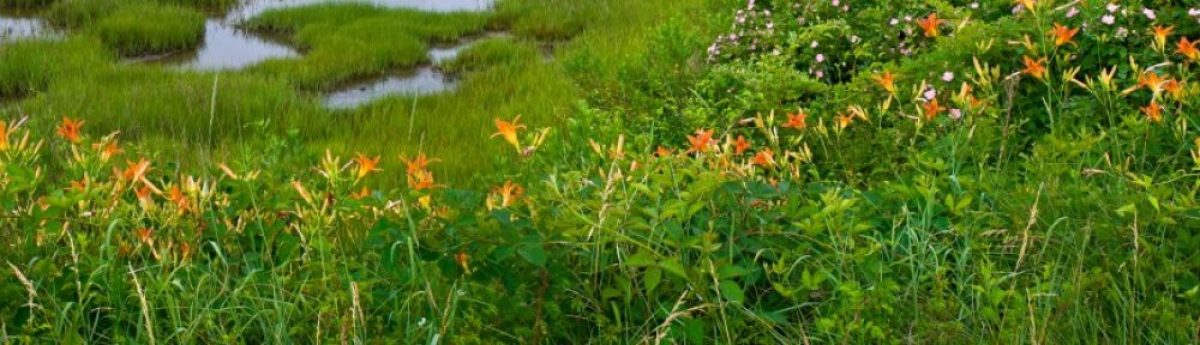
Some landscapes quietly become part of our lives. I took this photograph years ago on a midsummer walk through Sourland Mountain in New Jersey. The poem that follows grew from that same summer afternoon and carries with it the deep green stillness of July.
Sourland Mountain in July
The asphalt fajita pan sizzles, white papal smoke ascends from black aluminum, scorches naked feet, temperatures climb, calibrated for the appointed broiling of flesh—
Sourland Mountain at noonday in July: I listen to the psalms of emerald leaves upon twigs and branches uplifted in praise, the songs of the scarlet tanager, melodious with the orchestra of Monét clouds in this gated city of chlorophyll, a uniform green madness—
Though I walk through the hardness of rocks and boulders, I will not take this green for granted, I mumble on every single leaf of fern, weed and tree, revel in the uncomfortable warmth, while the green is teeming
at this very moment
before the gradual accumulated turnings of the universe, of sun, moon and stars awaken the coldness from its slumber, before the leaves turn into empty brown paper bags blown by the wind.
—Deirdra Vachal
From the poetry collectionWhere Love Dwells (2025) by Deirdra Garcia Vachal
𝐃𝐚𝐲 𝐒𝐚𝐢𝐥 The tide made docking difficult— I hold glowing coals from gripping ropes, my hair is a nest of straws harvested from ocean fields. I stand on the bow and watch you at the helm against a Monét sky, the coins of day spent, your face burnt and content from cranking chrome winches and pulling halyards amidst twenty knot winds: the sloop keeled at wild angles clowning with whitecaps, and the scents of salt and seaweed filled our nostrils and we soared with the seagulls. — D. G. Vachal from Vachal, D. G. (2026), The Turning of Light, (Amazon)
Stepping outside this evening, I was unexpectedly greeted by the lingering fragrance of honeysuckle climbing through the lilacs. The garden, at the end of May, seemed briefly suspended between bloom and fading.
Twilight and the Scent of Honeysuckle twilight— the scent of honeysuckle fills the lavender air, lilacs and dogwoods sing their last notes of song— twilight— the scent of white peonies intoxicates, while yellow and purple irises are at the tip of bloom, and day lilies await to explode in tangerine madness— twilight— at the end of May in my garden suspended between blossom and fading
Some poems come back to us differently over time. China Blue began in memory and longing, but also carries quieter inheritances—of Spain, of family, and of journeys that stretch farther back than I once understood. When my father brought his children and grandchildren to Spain, it felt less like travel than return. And somewhere behind the blue of memory lingers an older story still.
China Blue
China blue in my veins throbs with Valencia orange groves sways with weeping willows beside the bamboo-lined waters—
El Greco blue lines my heart-valves pulsates with nightingale songs dances with crimson chrysanthemums under the autumn sun—
Where the sun rises I greet the dwindling sunset speak the dialect of disparate vernaculars—
I straddle behind you on the motorcycle the sun tans our faces, your back rests content with my steady warmth —
we wander through little known byways where roads are rough and vines overgrow their bounds, and we meander with butterflies across meadows of wildflowers
then suddenly the sky breaks open, pours rain by the buckets, as wind and water pelt our faces and little streams flood our pathways —
I close my eyes, hold you close, in a little while you bring us to a tavern decked with rain-soaked begonias: we step inside, into laughter and song.
The Light by the Window the doorknob felt cold you stood there your eyes— I could not enter them only silence I waited for your voice to call me back only silence I stepped into the night the light by the window flickered blocked by your shadow
While reading Hermann Hesse’s “The Living Word” (from Seasons of the Soul), I was struck by a quiet and enduring truth: that the Word, however sacred, however beautiful, is never meant to be held at a distance. It must be lived, or it loses its life within us.
His poem does not argue this, it simply reminds. And in that reminder, something in me answered: What happens when truth is no longer contemplated, but encountered, when it is no longer spoken, but beheld?
I found myself returning to a poem I had written some time ago, and I now read it differently:
When Truth and I Behold Each Other
When Truth and I behold each other, my heart pulsates to the tempo of the soft- spoken mist of rain that tiptoes after the last bellow of the drunken thunder has been silenced —
I forget this leavened flesh, I am no longer a tree walking in my tannin espadrilles, the alabaster egrets carry my gesturing branches across the turquoise oceans —
I am left with my eyes sown in the meadow of the galaxies, primordial light-years turn transparent corneal sheaths into the sun’s corona —
the brilliance is beyond diamonds.
— D. G. Vachal
Perhaps this is one way of receiving the “living word” — not as something we hold, but as something that overtakes us, reshapes us, and carries us beyond ourselves.
Almost April — there is a moment just before spring fully arrives, when nothing seems to have changed, and yet, everything has already begun. Almost April when crocuses, aconites speckle colors on frigid earth, and buried bulbs unfurl their green fingers — Somewhere a cold cauldron sits atop a flame, warmth simmers: imperceptible as approaching dawn. Almost morning: when softest tones tiptoe through purple darkness, and wakening lark arises in radiant song, ruptures daybreak deafness. Almost laughter
— D. G. Vachal This poem is from my collection The Turning of Light a book that follows the quiet unfolding of the seasons within and around us. If you’d like to explore the full collection:
The Turning of Light Image (public domain): William J. Forsyth (American, 1854–1935), Crocuses, oil on canvas.
The cover of my second poetry book collection, The Turning of Light, features Claude Monet’s luminous painting, Woman With a Parasol, Facing Left (1886), one of the most beloved images of the Impressionist movement.
In the painting, Monet captured more than a woman standing in a field. He captured a moment of living light — clouds drifting across the sky, wind moving through tall grass, and sunlight shifting across the landscape.
Nothing in the scene is still. Light moves, the sky changes, and the moment itself seems to pass even as we look at it.
That quiet transformation of light lies close to the spirit of the poems in TheTurning of Light, which follow the turning of the seasons and the subtle ways time reshapes memory, love, and the inner life.
twilight at low tide: the seabed like a wide flat road stretches for a mile; across the distance the volcano stands, majestic against the changing sky —
I look back: the beach house my father built awaits, from the balcony, gas lamps flicker, orange flames glow in lavender light —
I walk with hermit crabs upon rocks and sand, gather sea urchins in my willow basket, my little feet soaked in shallow waters
this moment I am
with the sea as the tide turns, the volcano shrouded in twilight, the beach house silent, aglow.
the streetlamp stands tall, a lighthouse guiding my footsteps back — heartbeats pound my chest: a rhythmic sound like horse-hooves, from the tall grasses crickets chirp out of tempo, tonight I am bewildered by this strange evening music —
at the dormitory I pace the yellow tiled floor, from a distance young ladies sit at study tables with their tea and textbooks —
the night deepens, I tremble like a leaf in the wind, gravity forsakes me, I walk with the stars light years away, I am lost in a place no map can locate —
after restless sleep another day blossoms in the sky: a seed within me stirs from its slumber awakened by the stranger at sunset.
the sky was light mandarin
the first time we met
you, a stranger from far away,
my task to welcome you
to our land
for just a few hours —
you and I
walked to the bus stop
you with your crisp white shirt
long sleeves,
creaseless
I with a topsy-turvy skirt,
mismatched blouse
checkered,
floral,
yellow, pink, and green —
shy and tongue-tied was I
you spoke on through my silence
your footsteps
confident
upon the cobbled streets
while I stumbled on —
you found a place for us to dine,
a table where the light fell soft
upon your face
for the first time
I looked into your eyes
as you looked into mine —
the dusty red bus brought us back
to the same stop
there we said goodbye
your smile lighted the night’s darkness
it was then I knew
I would see you again.
A cold December night and the rain pummels the rooftops, drops colorless pearls on the kitchen window my reflection cloudy on the wet glass, as icicle fingertips put away pots and pans where they belong hidden until tomorrow’s bidding —
Long ago on a cold December night like this while the rain pummeled the rooftops, a porcelain cup broke gently, delicate Saxon flowers shattered on the floor as I knelt to collect the broken pieces, soft footsteps walked towards the door and in an eternal moment the door closed slowly like an ebbing tide —
A cold December night and the rain pummels my heart and once again the rain brings me back to a place of scattered Saxon flowers, a broken porcelain cup that once was whole.
Never was a month so motley in its days: November, penultimate month of a year that frames the seasons, when leaves in early days turn to brightest garnet, blazing topaz, illuminated gold —
the latter days arrive
with the fire of the winds, and the burning leaves take the plunge from infernal towers of the branches to the burial grounds of a gun- metal, brumal earth —
November, November, calves ache from the marathon, hearts pound the door to another December
when holly berries huddle upon the petals
of the soft-spoken snow,
and the fallen leaves breathe again
at the sound of the carols of the children,
the children rejoicing.
The turning of colors like the turning of tides, the waxing moon’s gradient shift to fullness in pearlescent light, the chilly air’s osmosis imperceptible, permeating a blanket of warmth —
emeralds turn to topaz, malachite to rubies, nightingale songs grow faint as in a moment’s dream —
I was here many times before and once again I am
swept in this lunatic array of colors: salmon and salamander, citrine and vermilion, french horns and trombone, a cacophony of shades and tinctures —
these moments soon will pass like many times before yet for a little while let me wrap myself in the colors of Autumn: Joseph’s coat of many colors.
Author’s note: This poem was inspired by a passage from “The Strings are False” by the Irish poet Louis MacNeice.
“The train for Jersey City was called the Blue Comet and I sat in a luxury Pullman car that was all windows and beyond the windows a reel of autumn madness, the maple trees gone drunk with colour. Tigers and wine, pimento, copper, coral, the bells of St. Clement’s jangling and fanfaronade of trumpets, fireworks out of the ground, Giorgione, Veronese, the tents of all the Sultans. People had told me about the American Fall, and this was it.” (“Louis MacNeice, The Strings are False, Faber and Faber Limited, Great Britain, 1965, p. 30.”)
How swiftly the season turns: moment passes by another moment as in my elusive nighttime dreams, all the while the ardor for life abides though cooler breezes quench the noonday fires —
I hear summer’s last melodies edged with change cedar waxwings whistle among the birches, the meadow edge hums with crickets and katydids, mourning doves croon their yearning calls into the twilight air —
evening approaches: a waxing half moon sheds silver threads upon the garden fronds, forest trees cast blurred shadows, open fields lie platinum pale half radiant, half shrouded, inlet waters quietly flow into their appointed oceans in albescent half-light —
last day of August I stand at the precipice of summer’s departure on a quarter moon evening, revealing yet secretive of what approaching Autumn holds.
April’s sapling arising from the fragrance of damp spring earth, tiny buds unfurl like infant fingers, release the first soft leaves, chartreuse as songbirds return, perch upon scrawny shoulders —
lengthening days drift with tides, clouds of egrets in flight, dawn dewdrops ephemeral upon blades of grass —
quickly comes August: the sapling’s girth thickens, networks of roots proliferate, dig deep like earthworms into warm soil, arms broaden from twigs to branches as thrushes thread through the canopy, warble with the rustle of emerald leaves, golden harp melodies in the cooling breezes.
My love, summer colors bloom with the glow we have known through the years beside you I stand bone of your bones, flesh of your flesh as in the wondrous days of Eden —
Take me to the dance of asters and anemones as we waltz with the westerly wind, warble with song sparrows, soar with the laughter of seagulls above iridescent sand dunes of northeastern shores —
these very moments
while the grass teems with greenness, imperceptibly the August warmth turns celadon clusters of grapes into purple, ripe for wine harvest.
In the ivory warmth of summer while frogs croak among the lily pads and rustling leaves make harp-like music, two squirrels scamper in a sprint one behind the other:
scurrying sounds, a tangled mass of fur, a frenzied steeple chase across freshly mown grass, then up the leaf-laden tree branches and down again, vanish into the swampy woods —
In the utmost heat of summer’s day while orange-winged cicadas buzz and whine and nikko blue hydrangeas droop from drought, two swallows break forth in ecstatic flight one behind the other:
chirps and gurgles, a tangled mass of feathers, ferris wheels in the air as they traverse gabled roofs, alight leaf-laden tree branches and up again, vanish into the azure sky —
Have you witnessed nature’s chase?
There is a time for playful pursuit, a time for slowing down, to gaze into each other’s eyes, walk hand in hand, vanish into the emerald forest.
at the end of daytime fever I hear the thunder rumbling in the distance a forgotten song from long ago —
is it you, my lost love, your beloved voice resonant in the clouds, a lament of lavender longing and the firefly lightnings —
did you come to let me know infinitely far from the miles of sky that you remember my smile, and how life would have been filled with flowers if we walked hand in hand in the summer rain, just you and I —
now comes the twilight, the rumbling thunder fades into a sigh and I walk in my garden alone with this poignant longing of holding your hand.
Miles have I traveled this dusty road, my feet throb from the journey’s pain as miniscule pebbles gather in my shoes, and slowing down I think upon you these ardent summer moments —
Will I ever find you again if I retrace my steps, remember the words I uttered when you were by my side —
I only know that if I turn back, the feeble light will fade and soon the darkness will engulf me.
I keep on walking, closer, closer towards the golden sky that sings a sentimental melody and for a fleeting moment I close my eyes —
I see your smile then I know you are beside me still.
Petals under moonlight on a night when the month of May is blooming: owls play their piccolos upon the branches, crickets, their castanets upon the watery grass —
Rejoice in the muted colors of the petals, foliage, sepals, beneath the cloak of temporal greyness —
When daylight alights, the greening of things innumerable will blaze across the fields of this fertile continent, drenched in the early rain, warmed by the beams of the morning sunlight.
“And this is life eternal, that they might know thee the only true God, and Jesus Christ, whom thou hast sent.” John 17:3
Life in this world is temporary and limited, but there is a life different from the mere existence that most human beings can comprehend. It is an amazing life, and it can be said that the reason the Son of God came into the world was to offer this kind of life to those who believe in Him. It is the gift of a life that lasts forever, measured not simply by its duration, but by its intense and distinctive quality.
Eternal life brings us into fellowship with God. Into this life are given the exceeding great and precious promises of God, enabling us to be partakers of the divine nature (2 Peter 1:4). When we are born again through faith in Christ, we do not simply become “better persons”; we share and participate in the very life and nature of God: we are in God, and God is in us, a mystical conception and a reality that is staggering to the human mind.
It is a life of purpose, sharing in God’s interests and objectives, whereby we become partners in God’s great plan of salvation for the world. We feel God’s grief over sin and see evil as a real force that manipulates the lives of mankind in their enmity against God. Hence we live to push forward the kingdom of light against the kingdom of darkness.
God becomes very real to us. We are steadily aware and certain of His presence. It is a life of communion with God and knowing Him as our Father, recognizing that we are never alone because God is constantly with us and that our lives are in His hands.
Eternal life is knowing God. What could be more amazing than that?
* Reference: Martyn Lloyd-Jones, Fellowship With God, Crossway Books, Wheaton, Illinois, 1993, pp. 56-85
D. G. Vachal 2012, 2025 * Photography: Sunrise by Knowles Gallery @ Flickr cc
Here you come once again with your delicate rains: petals break forth like the rainbow while scarlet-breasted robins alight upon the thickening carpet of emerald grass —
You perplex me so: warm and cold, endearing and aloof, the way long-forgotten loves drove me to the very edge of madness —
O April, enshroud me in the intimacy of your mysteries, then will I comprehend the reason for the ethereal blossoms fragrant in the month of May.
“A lazy man does not roast his prey,but the precious possession of a man is diligence.” Proverbs 12:27, NASB
There is a certain possession that the Bible esteems as valuable, something to be desired. It is not a material treasure; it cannot be bought with worldly currency. That precious possession is diligence.
The best way I can expound upon this scripture is to share how I have witnessed this trait in the way my parents lived. To this day, they continue to amaze me beyond words. I don’t ever remember seeing them idle or wasting time. When I was growing up, I recall both of them going to work early in the morning each day. As both of them are lawyers, they had plenty of things to occupy them, but they somehow managed to come home and eat three meals with their children almost every day.
When my father was home, I remember that he would either be reading or writing. My mother incessantly tended to projects that she would follow through to completion. They were compassionate people, reaching out to help the poor and underprivileged. I remember many times when we children would have to sit squeezed shoulder-to-shoulder at the dinner table because some poor folks were invited to dine with us.
My father is now in his eighties, but he still goes to work every day: he serves the people as the oldest member of Congress in an Asian country. Surrounded with books and so many documents to read and review, he always carries a pen, a small pad of paper, or a book to read. My mother is in her late seventies, and yes, she also works at her office each day. A long time ago, when I was a little child, she started a cooperative to help and encourage poor people to save their money and to free them from the grasp of greedy usurers. What she set into motion decades ago has now grown by leaps and bounds — from a small group of less than 20 people, and now currently reaching almost a hundred thousand members.
Diligence involves perseverance, persistence, and tenacity. It is not achieved overnight, but grows through the days and through the years as it is applied. It is honoring one’s Creator with making the best use of one’s time and talents, and like the cooperative that my mother once started, through daily application, grows exponentially in value. Diligence eventually becomes a person’s precious possession where moths cannot corrupt, nor can thieves break through and steal.
Cold tentacles
hold on
to burgeoning branches
beneath the April sun:
yellow butterflies alight
upon celadon lapels
of petal-packed corollas —
Skies are cyan, crystal-clear,
embossed with goose
down pillows
soaked
in alabaster dreams —
There are treasures in the morning,
this platinum morning:
emerald and gold
glimmer
over infantile leaves
of oak and elm —
ruby and sapphire,
topaz, turquoise and amethyst
sparkle
in the tranquil blooming
of the promised flowers.
Return of the Prodigal Son by Bartolome Esteban Murillo 1667-1670
Love’s Justice
Is love inconsistent with justice in our human interactions? At times we hear the words “tough love” uttered by parents who wish to instill in their children some important life lesson, and often there is a struggle in determining a clear set of determining principles as to how this process is to be carried out.
Jesus tells a story about a father and his two sons. One son was dutiful and stayed home to work for his father. The other was rebellious: he demanded his inheritance upfront, went to a far country, and spent all his resources on riotous living. When his money ran out, and he recognized the error of his ways, he repented and journeyed back home, hoping he would find work as one of his father’s servants.
But instead of giving a scathing rebuke for all that the wayward son had done, the father adorned his son with the best robe, put a ring on his finger, and sandals for his feet. Then he ordered the fatted calf to be killed, and a feast prepared. The dutiful son was terribly upset at his father’s actions towards his long-lost brother. He refused to join in the feast and stayed outside in the darkness of his own creation — the darkness of a harsh spirit and a lack of love for his sibling.
A strange story perhaps, for there was no logical and expected justice served to the wayward son, but a total reversal of expected outcomes: the obedient son is standing outside in darkness, while the rebellious son is reveling inside the house, feasting with his father.
What then, becomes of justice in this story? Jesus gives the assurance that Love is the only real justice, for the main purpose of justice is not punishment, but reclamation. A justice that is truly enlightened is less concerned with the punishment of wrong than its reparation.
Had the father issued a harsh verdict against the prodigal son, coldly dismissing him, he would have been unjust to his son’s future potential, and thus would have sinned a more grievous sin against his own son. The worst sinner in the story was the son who did everything right, and yet acted in a vile, censorious, loveless way towards his brother.
One who does not love cannot be just.
God is Love, and God’s forgiveness is God’s justice, for if we acknowledge the error of our ways, and head back home to Him, He is faithful and just to forgive us our shortcomings, and to restore us into fellowship with Him, our Heavenly Father, through His Son Jesus Christ.
References:
* William J. Dawson, “The Empire of Love”, New York: Fleming H. Revell Company, 1907, pp 33-44.
* Luke 15: 11-32, King James Version


You must be logged in to post a comment.