“And he shall be like a tree planted by the rivers of water, that bringeth forth his fruit in his season; his leaf also shall not wither; and whatsoever he doeth shall prosper. The ungodly are not so: but are like the chaff which the wind driveth away.” Psalm 1:3-4
In comparing the wise man with the foolish man, Jesus used the illustration of two houses: one built upon the rock, and the other upon the sand. Contrasting the godly with the ungodly, however, King David used two profoundly disparate symbols: a tree by rivers of water, and chaff.
Why did King David compare the ungodly with chaff? Perhaps we can infer how he appraised them by considering the characteristics of chaff.
It is what remains when the grain is removed, a relic of something that was once alive. The ungodly are like husk, King David said; everything that is vital and of value is gone. They are separated from God, the source of life.
Chaff has no form, consistency, or structure. In the same way, the ungodly have no pattern in their lives; they seem to be ever changing with the whims of the world, the fashion of the times. They are people who are difficult to define.
Chaff has no roots. A heap of chaff can be scattered by the wind or trodden underfoot, with no definable shape; it follows where it is moved. Likewise, the ungodly have no foundation, living a life with no definitive principles.
Chaff cannot bear fruit. A godless life finds out in the end that all the dazzling prizes of the world are nothing but a heap of empty shells. A life without God cannot give satisfaction and joy to the human soul.
Such is the life of a man or a woman without God. But the good news is that the Son of God, Jesus Christ, came into this world as a human being to “seek and save that which is lost”. He came to rescue the ruins of the soul by dying on the cross and bearing the punishment for our sins. Through faith in Him, we become a new creation: we receive new life, the sustaining grain and power within the husk.
* Reference: D. Martyn Lloyd-Jones, “True Happiness”, Gwasg Bryntiron Press, Wales, UK, 1967, pp. 29-50
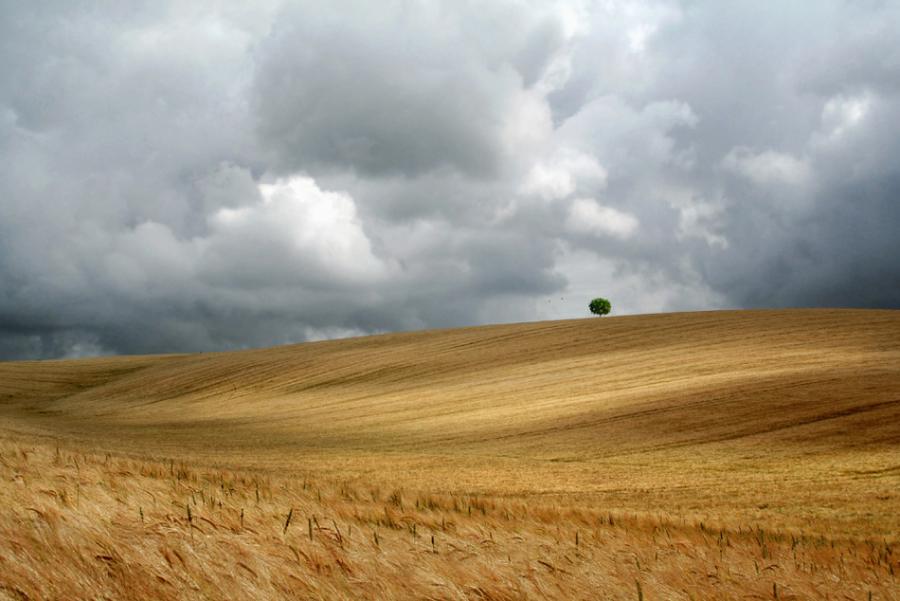
* Photograph: Lonesome Tree by Rove
 lilies, sparrows and grass
You must be logged in to post a comment.