How Faith Overcomes

“ For whoever is born of God overcomes the world: and this is the victory that overcomes the world, even our faith.” I John 5:4

Faith is the victory that overcomes: what an astounding tautology put forth by the Apostle John! Certainly a lofty concept, but let us consider how our faith in Christ makes overcoming the world a practical and actual possibility.

First, believing that Jesus Christ is indeed the Son of God gives us the capacity to rest upon the power and ability of Christ, the One who conquered death and is alive forevermore.

“The name of the Lord is a strong tower; the righteous run into it and are safe” 1 Just as men of old ran to the tower to seek safety from their enemies, in the simplicity of our faith, we run to Christ, use His powerful name, hide in Him in a literal sense for protection, defense, and deliverance. We rely utterly upon Him. This is what is called “the great strategy of faith”, the assurance of the possibility that is open to us, that we can go to Christ directly, immediately, and simply look to Him and rest in Him. And when the battle rages on and we feel that we are at the point of falling, we simply cry “Jesus”, and believe and know that He is at hand to deliver and protect us.  As little children, we do not look at the enemy, but simply rely upon Him.  Victory is in Him, in His power, and not in ourselves.

Second, we use faith in an active sense.  We deliberate upon the Christian gospel and ponder what faith in Christ really means in terms of this fight we face against the world, the flesh and the devil.  We consider Jesus Christ in relation to this battle: that He took upon the likeness of sinful flesh because of the power of Satan, of sin and of evil, that He came because He is the only way by which we could be delivered from these overpowering forces. And in His life, death and resurrection, Christ overcame these powers.

As we see ourselves belonging to Christ, we realize that we share in His victory and everything that belongs to Him. Our whole perspective towards this fight changes: because Christ has overcome the world, and because we are in Him, then we have overcome.  In a practical sense, being in Christ enables us to see that we can literally draw strength and power from Him and from His fullness; we have inexhaustible resources behind us, we have a source of supply that can never fail. There is absolutely no limit to the power of Christ.

And in our human frailty, when we sin and fall back, there is forgiveness in Christ. There is nothing that so enables us to overcome as this deliverance from our sins and failures, the freedom from that overwhelming sense of despair, so we can arise again and continue our journey through life.

Lastly, faith enables us to behold the ultimate glory and perfection that await us.  Our hearts are encouraged though the fight may seem arduous and endless.  Faith makes us realize that Christ, who died for us and sustains us in this world, will one day present us faultless before the presence of God with exceeding joy.

And this is the victory that overcomes the world, even our faith.

*** 1  Proverbs 18:10

***Reference:  Martyn Lloyd Jones, Life In Christ, Crossway Books, Wheaton Illinois, 2002, pp. 604-613.

*** Photo: Elie Tower by Dimitri


To Overcome the World

“ For whosoever is born of God overcomes the world. And this is the victory that overcomes the world, even our faith. Who is he that overcomes the world, but he who believes that Jesus is the Son of God?”  I John 5:4-5

The apostle John warns against loving the “world”, succinctly described in his epistle as the lust of the flesh, the lust of the eyes, and the pride of life.

The “world” can be defined as an outlook, a system of thought that is opposed to God:  it strives to separate us from God, persecutes us for loving Him,  and obstructs us from glorifying Him in our lives. It is an overwhelming force that engulfs us as we seek to live a life pleasing to the Father.

How do we overcome the world?

The monastic position advocates withdrawing from the world and emphasizes the use of discipline and willpower as well as observance of rules and regulations.  But a mechanical and physical departure alone ultimately does not offer an escape from the “world” that operates within a person: the pride of self and natural lusts.  And consider that Christ, the One who overcame the world, lived a public life; He did not withdraw from the world, but interacted with people from all walks of life, including sinners and winebibbers.

How then do we arrive at a position of overcoming the world?  Let us consider the biblical view.

First, we overcome the world by being born of God. Whoever is born of God overcomes the world. The Christian has a new disposition, a new outlook, a perception of the world as the Lord Jesus Christ saw it.  We become “partakers of the divine nature” (2 Peter 1:4), hence we look at things from God’s vantage point, not from the carnal and sinful point of view of natural man.  There is a hope that anchors us within our inner selves, in spite of us being in the world, placing us in a position to overcome it.

Second, the new birth gives us this faculty which enables us to live a life of faith.  This is the victory that overcomes the world, even our faith. The world is a formidable foe and we are powerless to fight it by our own strength. We need emancipation, to be lifted to another realm, to be given a strength and power beyond ourselves, and greater than the world.  Being born again through Christ introduces us to a higher dimension, with a power available to us to enable us to have victory over the world.

Third, we overcome the world by our relationship to Jesus Christ, to Christ’s work, and what has already been accomplished at the cross.  Who is he who overcomes the world, but he who believes that Jesus is the Son of God?  Therefore, withdrawal from the world and following ascetic rules is entirely unnecessary and ineffectual because everything we need to be victorious is already found in the person of the Lord Jesus Christ.

Through the new birth, we are able to exercise our faith in Christ, to rest in Him, to receive and draw upon His fullness. And as Christ glorified the Father, so can we, as we live our lives victorious over the world.

** Reference: Martyn Lloyd-Jones, Life in Christ,Crossway, Wheaton, Illinois, 1982, pp. 585-603.

** Photograph:  Body Surfer by Chuck Babbitt

At the Gate Beautiful: A Parable of Purpose

Then Peter said, Silver and gold have I none; but such as I have give I thee: In the name of Jesus Christ of Nazareth rise up and walk.” Acts 3:6

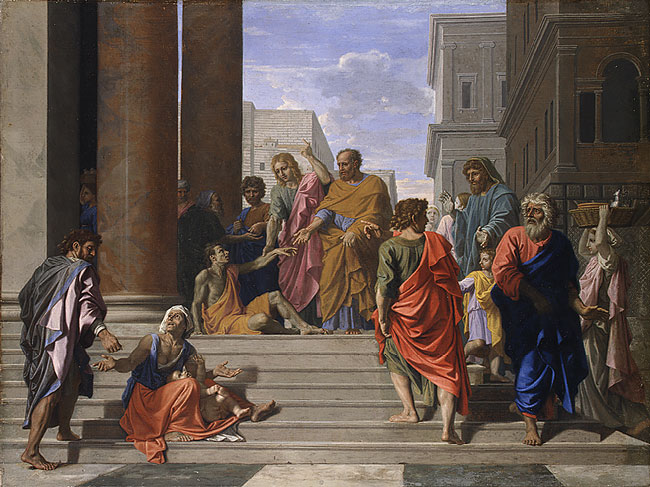
Reflecting upon the healing of the lame man at the Gate Beautiful, one can infer a parable that illustrates the purpose and function of the Christian Church.

Here was a man lame from birth, carried daily to the temple so he could ask for alms. His paralysis is a metaphor of the biblical view of the condition of mankind: we are born in sin, lost, and crippled in our ability to conquer the devil, temptation, and sin solely by our own strength.

The world is unable to address the problem of sin. All it can do is to give “alms”. We can turn to entertainment, art, literature, music, philosophy, and science, but these only give temporary relief, a momentary escape from our problems.

Just as the lame man was expecting “alms” from Peter and John, mankind often expects the wrong things from the Church, stemming from erroneous notions about its message and function.  People expect moral advice, philosophical teaching, or perhaps psychological treatment. At times, they expect the Church to give political pronouncements on what needs to be done in terms of social issues.

But Peter declares the primary and essential purpose of the Church in a resounding and memorable phrase:  “Silver and gold have I none; but such as I have I give you: in the name of Jesus Christ of Nazareth rise up and walk.”

Silver and gold have I none. The business of the Church is not to “give alms”, but to deal with the real problem of man, to be here for one thing: man’s soul. Here is the call, the commission for which the Church is sent: not to be a cultural, psychological, political or social entity, but that which is concerned about the very center of man’s life and his problem:  the dilemma of the paralysis in his soul, that which incapacitates him and sends him astray — his estrangement from God, his ignorance of God.

In response to the man’s need, Peter deliberately points to Jesus, the carpenter of Nazareth, who is the Christ, the Messiah in the flesh: the One who has the power to heal man’s disabled soul, to give him a new life, to reconcile him to God.

What the lame man received through Peter surpassed all his expectations.  He expected alms, but instead the bones of his once lifeless feet and ankles received strength. He became a man now able to live a fully functional life.

What a person receives from Christ is not temporary relief, but a cure. The Lord cures our guilt from past sins because He gives us absolute forgiveness through His shed blood on the cross.  He gives us an abundant life through the new birth. A fresh beginning.

As we walk with Christ and discover the power and unspeakable joy that He offers us in this new life, surely we cannot help but go through our days on earth leaping and praising God!


*** Reference:  Martyn Lloyd-Jones Sermon: Healing of the Lame Man at the Gate Beautiful

*** Painting: by Nicolas Poussin, 1655  (French, 1594-1665), http://www.metmuseum.org

The Sorrow of Forsaking Christ

Then Jesus, looking at him, loved him, and said to him, “One thing you lack: Go your way, sell whatever you have and give to the poor, and you will have treasure in heaven; and come, take up the cross, and follow Me.”  But he was sad at this word, and went away sorrowful, for he had great possessions.” Mark 10:21-22

Can great worldly possessions cause sorrow?  A wealthy young ruler’s encounter with Christ left him grieving because of the choice he made.

At the outset, he came running to Jesus, knelt by Him, and asked what he must do to inherit eternal life.  Here was a man who seemed to possess everything in life: he was noble and excellent, and yet he felt that something was missing. There was this concept of eternal life which gave him a curious desire to attain.  He sensed the urgency. He came running.

He asked the right question, but when Jesus gave him the answer, he walked away.  Why did he give up his pursuit of eternal life?

He expected Christ to confirm his own preconceived notions about the Kingdom of God. The Lord demolished his understanding.  Attaining eternal life is not simply a matter of following God’s commandments; it demanded something else. Christ probed into the very depths and center of his being and exposed his real dilemma: his trust in riches, his pride and confidence in them.

”Give it away”, says Christ, “and let me decide.”  The kingdom of God must be entered Christ’s way. It is a radical transformation, the way of the cross, of following in Christ’s footsteps.

He did not like Christ’s answer. He walked away, deciding to hold on to his possessions and the life he was accustomed to. But in leaving, he was sorrowful. A deep heaviness engulfed him as he opted for worldly riches over eternal life, as he walked away from Christ.

Judas turned his back on Christ and was filled with such remorse and sorrow that he took his own life.  To abandon Christ is spiritual suicide, to turn away from eternal life, from the only one who can give true riches, happiness, joy and peace.

Oh do not walk away from Christ! If you leave Him, you will have left your last and only hope, and nothing else remains but grief and eternal unhappiness. Run towards Him, embrace Him, and never let Him go.

*** Reference: Martyn Lloyd-Jones, “The Kingdom of God”, Crossway Books, Wheaton, Illinois, 2010, pp. 155-172.

*** Photography: After Sunset by Andrew Koksharov

From a Slow Heart to a Burning Heart

And they said to one another, “Did not our hearts burn within us while He talked with us on the way and while He opened to us the Scriptures?” Luke 24:32

On Resurrection Day, two men’s hearts were changed on the road to Emmaus.  At the outset, when Jesus met them on their journey, He described them as “fools and slow of heart to believe”.

They were men who had slow, sluggish hearts:  so engulfed were they in recounting the terrible things that happened to Jesus two days before, mulling over how He was crucified and put to death by the chief priests and rulers.  Jesus, the One they thought would redeem Israel from all her enemies and woes, the earthly Messiah who would bring peace and prosperity to their homeland. Now their hopes were demolished.

They had a different vision and all they deliberated upon was Christ’s misfortune, overlooking what they had heard that very same day, that early in the morning, certain women went to the sepulcher, saw a vision of angels and an empty grave. Slow and heavy hearts dwell upon the worst things that have happened and never get past these events.

As Jesus walked with them and discussed the Scriptures, starting from Moses and all the prophets, slowly a kindling in their hearts began, and around sunset, when they approached Emmaus, their hearts were burning … “Were not our hearts burning within us while he talked with us on the road and opened the Scriptures to us?

What a tremendous transformation, such that after Jesus disappeared from their midst at Emmaus, “on the same hour”, they excitedly headed all the way back to Jerusalem, to walk another seven miles, in the darkness of evening, to be with the eleven apostles.  They could not contain themselves, they had so much fire within them, their hearts were raging to deliver one message: “The Lord is risen indeed”.

Hearts slow to believe were transformed to quickened, burning hearts of faith when Jesus walked with them, talked with them, and opened the Scriptures to them.