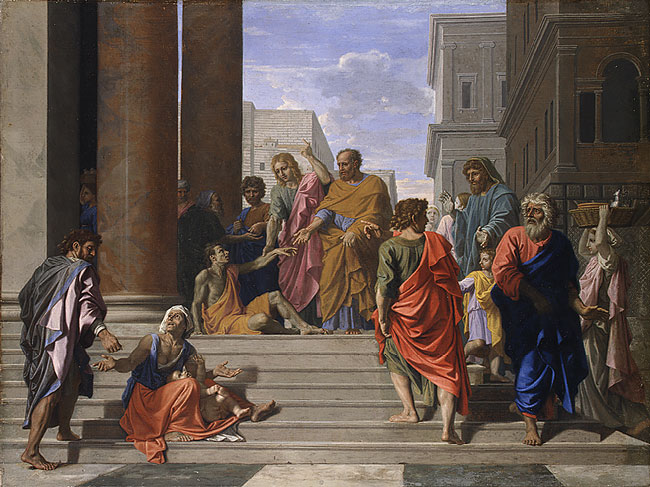
“Then Peter said, Silver and gold have I none; but such as I have give I thee: In the name of Jesus Christ of Nazareth rise up and walk.” Acts 3:6
Reflecting upon the healing of the lame man at the Gate Beautiful, one can infer a parable that illustrates the purpose and function of the Christian Church.
Here was a man lame from birth, carried daily to the temple so he could ask for alms. His paralysis is a metaphor of the biblical view of the condition of mankind: we are born in sin, lost, and crippled in our ability to conquer the devil, temptation, and sin solely by our own strength.
The world is unable to address the problem of sin. All it can do is to give “alms”. We can turn to entertainment, art, literature, music, philosophy, and science, but these only give temporary relief, a momentary escape from our problems.
Just as the lame man was expecting “alms” from Peter and John, mankind often expects the wrong things from the Church, stemming from erroneous notions about its message and function. People expect moral advice, philosophical teaching, or perhaps psychological treatment. At times, they expect the Church to give political pronouncements on what needs to be done in terms of social issues.
But Peter declares the primary and essential purpose of the Church in a resounding and memorable phrase: “Silver and gold have I none; but such as I have I give you: in the name of Jesus Christ of Nazareth rise up and walk.”
Silver and gold have I none. The business of the Church is not to “give alms”, but to deal with the real problem of man, to be here for one thing: man’s soul. Here is the call, the commission for which the Church is sent: not to be a cultural, psychological, political or social entity, but that which is concerned about the very center of man’s life and his problem: the dilemma of the paralysis in his soul, that which incapacitates him and sends him astray — his estrangement from God, his ignorance of God.
In response to the man’s need, Peter deliberately points to Jesus, the carpenter of Nazareth, who is the Christ, the Messiah in the flesh: the One who has the power to heal man’s disabled soul, to give him a new life, to reconcile him to God.
What the lame man received through Peter surpassed all his expectations. He expected alms, but instead the bones of his once lifeless feet and ankles received strength. He became a man now able to live a fully functional life.
What a person receives from Christ is not temporary relief, but a cure. The Lord cures our guilt from past sins because He gives us absolute forgiveness through His shed blood on the cross. He gives us an abundant life through the new birth. A fresh beginning.
As we walk with Christ and discover the power and unspeakable joy that He offers us in this new life, surely we cannot help but go through our days on earth leaping and praising God!
*** Reference: Martyn Lloyd-Jones Sermon: Healing of the Lame Man at the Gate Beautiful
*** Painting: by Nicolas Poussin, 1655 (French, 1594-1665), http://www.metmuseum.org




 lilies, sparrows and grass
You must be logged in to post a comment.