Limiting God

“Yes, they turned back and tempted God, and limited the Holy One of Israel.” Psalm 78:41

Asaph described the actions of the Israelites in Psalm 78 as “limiting the Holy One of Israel”.  What does it mean to “limit God”?   Are there limits to what God can do?

God is limited to His character.  He cannot sin.  He cannot lie.  And God has imposed certain limits on Himself, requiring certain actions from His creation before He will allow Himself to act.1 In this sense, we limit God through our actions, according to the limits He sets for Himself.

How then do we limit God? As we read the epistles, we find certain patterns and norms highlighting what God has made possible for a Christian in this life and in this world. To the extent that we are not living up to these standards, we are limiting God as to what He can do in our lives. And tragically, we limit the world’s perception of the God we profess by our shortcomings in these areas.

The first standard is the assurance of salvation, the confidence that our sins are forgiven.  Do we know God and feel His presence in an intimate and real sense? Are we absolutely certain of His love for us, and that we are joint heirs with Christ?  If there is uncertainty about the marks of this assurance of our salvation, then we are limiting God.

Second, we are meant to be a rejoicing people. Do we rejoice in tribulation, even in the very midst of trials?  Can we proclaim these words, as did the prophet Habakkuk:

Although the fig tree shall not blossom, neither shall fruit be in the vines; the labor of the olive shall fail, and the fields shall yield no meat; the flock shall be cut off from the fold, and there shall be no herd in the stalls: Yet I will rejoice in the Lord, I will joy in the God of my salvation.”  ?  (Habakkuk 3:17-18)

If we are miserable Christians and are still turning back to the world for our happiness, then we are limiting God and all the glorious possibilities He holds out before us.

Third, we are to delight in God and His commandments.  His commandments are not grievous (I John 5:4), because they are light and life to us, where the alternative is only darkness.  Filled with grumbling and complaining, the Israelites in the wilderness envied other nations and murmured against God and His commands. But God meant for us to enjoy His Word and His laws.  The psalmist declared his love for God’s law, and yet we as Christians are in a superior position than the psalmist because we share in the fullness of Christ. Do we find God’s commandments grievous?  If we consider our Christianity as merely a matter of duty, then we are limiting God.

Fourth, we are to enjoy the peace of God.  The Israelites were unhappy, restless and confused, not allowing God to give them His comfort and peace.  If we are in a true, loving relationship with God, we can know this peace that cannot be disturbed.  Not knowing this peace as a reality is to put a limit to what God has made available to us.

Finally, we are to rest in Him and in His all-sufficiency.  The apostle Paul learned in whatsoever state he was, to be content.  Is this our experience? Do we know Christ to be our all-sufficiency, that we can do all things through Him?  Do we know something about days of heaven upon earth, how it feels to have God in our midst?  If not, then we are limiting His power and His grace to have full reign in our lives.

All of these things are available and made possible for us through Christ. If we have come short of any of these ideals, we need to repent and run back to God the soonest we can:  to open our hearts, believe His promises,  to ask and expect great things from Him, for the enrichment of our souls, and for His glory.

References:
*** 1 Martin G. Collins, Sermon: Limiting the Holy One of Israel Part 1: Examining Ourselves by God’s Standards

*** Martyn Lloyd-Jones, Sermon: Limiting God

*** Photograph: Stairs to the Sea by Queralt  jqmj @Flickr cc

How Faith Overcomes

“ For whoever is born of God overcomes the world: and this is the victory that overcomes the world, even our faith.” I John 5:4

Faith is the victory that overcomes: what an astounding tautology put forth by the Apostle John! Certainly a lofty concept, but let us consider how our faith in Christ makes overcoming the world a practical and actual possibility.

First, believing that Jesus Christ is indeed the Son of God gives us the capacity to rest upon the power and ability of Christ, the One who conquered death and is alive forevermore.

“The name of the Lord is a strong tower; the righteous run into it and are safe” 1 Just as men of old ran to the tower to seek safety from their enemies, in the simplicity of our faith, we run to Christ, use His powerful name, hide in Him in a literal sense for protection, defense, and deliverance. We rely utterly upon Him. This is what is called “the great strategy of faith”, the assurance of the possibility that is open to us, that we can go to Christ directly, immediately, and simply look to Him and rest in Him. And when the battle rages on and we feel that we are at the point of falling, we simply cry “Jesus”, and believe and know that He is at hand to deliver and protect us.  As little children, we do not look at the enemy, but simply rely upon Him.  Victory is in Him, in His power, and not in ourselves.

Second, we use faith in an active sense.  We deliberate upon the Christian gospel and ponder what faith in Christ really means in terms of this fight we face against the world, the flesh and the devil.  We consider Jesus Christ in relation to this battle: that He took upon the likeness of sinful flesh because of the power of Satan, of sin and of evil, that He came because He is the only way by which we could be delivered from these overpowering forces. And in His life, death and resurrection, Christ overcame these powers.

As we see ourselves belonging to Christ, we realize that we share in His victory and everything that belongs to Him. Our whole perspective towards this fight changes: because Christ has overcome the world, and because we are in Him, then we have overcome.  In a practical sense, being in Christ enables us to see that we can literally draw strength and power from Him and from His fullness; we have inexhaustible resources behind us, we have a source of supply that can never fail. There is absolutely no limit to the power of Christ.

And in our human frailty, when we sin and fall back, there is forgiveness in Christ. There is nothing that so enables us to overcome as this deliverance from our sins and failures, the freedom from that overwhelming sense of despair, so we can arise again and continue our journey through life.

Lastly, faith enables us to behold the ultimate glory and perfection that await us.  Our hearts are encouraged though the fight may seem arduous and endless.  Faith makes us realize that Christ, who died for us and sustains us in this world, will one day present us faultless before the presence of God with exceeding joy.

And this is the victory that overcomes the world, even our faith.

*** 1  Proverbs 18:10

***Reference:  Martyn Lloyd Jones, Life In Christ, Crossway Books, Wheaton Illinois, 2002, pp. 604-613.

*** Photo: Elie Tower by Dimitri


To Overcome the World

“ For whosoever is born of God overcomes the world. And this is the victory that overcomes the world, even our faith. Who is he that overcomes the world, but he who believes that Jesus is the Son of God?”  I John 5:4-5

The apostle John warns against loving the “world”, succinctly described in his epistle as the lust of the flesh, the lust of the eyes, and the pride of life.

The “world” can be defined as an outlook, a system of thought that is opposed to God:  it strives to separate us from God, persecutes us for loving Him,  and obstructs us from glorifying Him in our lives. It is an overwhelming force that engulfs us as we seek to live a life pleasing to the Father.

How do we overcome the world?

The monastic position advocates withdrawing from the world and emphasizes the use of discipline and willpower as well as observance of rules and regulations.  But a mechanical and physical departure alone ultimately does not offer an escape from the “world” that operates within a person: the pride of self and natural lusts.  And consider that Christ, the One who overcame the world, lived a public life; He did not withdraw from the world, but interacted with people from all walks of life, including sinners and winebibbers.

How then do we arrive at a position of overcoming the world?  Let us consider the biblical view.

First, we overcome the world by being born of God. Whoever is born of God overcomes the world. The Christian has a new disposition, a new outlook, a perception of the world as the Lord Jesus Christ saw it.  We become “partakers of the divine nature” (2 Peter 1:4), hence we look at things from God’s vantage point, not from the carnal and sinful point of view of natural man.  There is a hope that anchors us within our inner selves, in spite of us being in the world, placing us in a position to overcome it.

Second, the new birth gives us this faculty which enables us to live a life of faith.  This is the victory that overcomes the world, even our faith. The world is a formidable foe and we are powerless to fight it by our own strength. We need emancipation, to be lifted to another realm, to be given a strength and power beyond ourselves, and greater than the world.  Being born again through Christ introduces us to a higher dimension, with a power available to us to enable us to have victory over the world.

Third, we overcome the world by our relationship to Jesus Christ, to Christ’s work, and what has already been accomplished at the cross.  Who is he who overcomes the world, but he who believes that Jesus is the Son of God?  Therefore, withdrawal from the world and following ascetic rules is entirely unnecessary and ineffectual because everything we need to be victorious is already found in the person of the Lord Jesus Christ.

Through the new birth, we are able to exercise our faith in Christ, to rest in Him, to receive and draw upon His fullness. And as Christ glorified the Father, so can we, as we live our lives victorious over the world.

** Reference: Martyn Lloyd-Jones, Life in Christ,Crossway, Wheaton, Illinois, 1982, pp. 585-603.

** Photograph:  Body Surfer by Chuck Babbitt

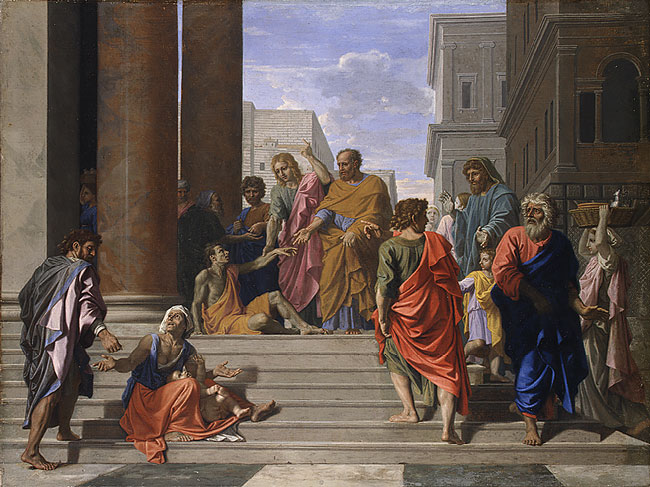
At the Gate Beautiful: A Parable of Purpose

Then Peter said, Silver and gold have I none; but such as I have give I thee: In the name of Jesus Christ of Nazareth rise up and walk.” Acts 3:6

Reflecting upon the healing of the lame man at the Gate Beautiful, one can infer a parable that illustrates the purpose and function of the Christian Church.

Here was a man lame from birth, carried daily to the temple so he could ask for alms. His paralysis is a metaphor of the biblical view of the condition of mankind: we are born in sin, lost, and crippled in our ability to conquer the devil, temptation, and sin solely by our own strength.

The world is unable to address the problem of sin. All it can do is to give “alms”. We can turn to entertainment, art, literature, music, philosophy, and science, but these only give temporary relief, a momentary escape from our problems.

Just as the lame man was expecting “alms” from Peter and John, mankind often expects the wrong things from the Church, stemming from erroneous notions about its message and function.  People expect moral advice, philosophical teaching, or perhaps psychological treatment. At times, they expect the Church to give political pronouncements on what needs to be done in terms of social issues.

But Peter declares the primary and essential purpose of the Church in a resounding and memorable phrase:  “Silver and gold have I none; but such as I have I give you: in the name of Jesus Christ of Nazareth rise up and walk.”

Silver and gold have I none. The business of the Church is not to “give alms”, but to deal with the real problem of man, to be here for one thing: man’s soul. Here is the call, the commission for which the Church is sent: not to be a cultural, psychological, political or social entity, but that which is concerned about the very center of man’s life and his problem:  the dilemma of the paralysis in his soul, that which incapacitates him and sends him astray — his estrangement from God, his ignorance of God.

In response to the man’s need, Peter deliberately points to Jesus, the carpenter of Nazareth, who is the Christ, the Messiah in the flesh: the One who has the power to heal man’s disabled soul, to give him a new life, to reconcile him to God.

What the lame man received through Peter surpassed all his expectations.  He expected alms, but instead the bones of his once lifeless feet and ankles received strength. He became a man now able to live a fully functional life.

What a person receives from Christ is not temporary relief, but a cure. The Lord cures our guilt from past sins because He gives us absolute forgiveness through His shed blood on the cross.  He gives us an abundant life through the new birth. A fresh beginning.

As we walk with Christ and discover the power and unspeakable joy that He offers us in this new life, surely we cannot help but go through our days on earth leaping and praising God!


*** Reference:  Martyn Lloyd-Jones Sermon: Healing of the Lame Man at the Gate Beautiful

*** Painting: by Nicolas Poussin, 1655  (French, 1594-1665), http://www.metmuseum.org

The Attributes of Love

“Beloved, let us love one another, for love is of God; and everyone who loves is born of God and knows God.” I John 4:7

As children of God, we are commanded to love one another. If it were simply a matter of liking one another, then our obedience would easily be fulfilled. The commandment to love, however, is more difficult to accomplish.

What is the difference between liking and loving a person?

The two concepts are not degrees of the same thing. To like somebody is something instinctive and elemental; it does not necessitate effort; it comes naturally and is dependent to a large degree upon the physical senses and outward appearances.

The word “love” has sadly been debased and misused in modern parlance, often being associated with infatuation. But love is something that must be thought of in terms of God, because the Bible tells us that God is love.

Love is a highly intelligent process. In contrast to liking somebody, love is not driven by instinct or natural responses, but operates at a higher level. It is determined to go beyond the superficial, infiltrating the inner person, to dig into something deeper and of more value. Love overcomes obstacles and excuses, overlooks the superficial unattractiveness, in order to behold the person behind the imperfections.

We employ our mental faculties, as an act of the will, to love even the people we do not like; we treat them as if we do like them, and choose to act with kindness towards them in spite of our natural feelings.  It is an act of obedience.

And yet there is more to love.   As the apostle John asserts: “But whoever has the world’s goods, and sees his brother in need and closes his heart against him, how can the love of God abide in him?” I John 3:17

Love drives us out of our seat of theorizing and romanticism, to do something about easing the pain of our fellowman. By its very nature love must express itself, not in words, but in actions.

Such are the salient attributes of love, and the reason we are commanded to love one another is because love is of God. And love is the litmus test of our being born of God, of our knowing God, and of our passing from death unto life.

** Reference: Martyn Lloyd-Jones, Life in Christ, Crossway:Wheaton, Illinois, 1982, pp. 357-366.

** Photograph: On Golden Pond by Artemis