The Years, My Friend

Winter by Farhad
The Years, My Friend

The years, my friend, have not been kind
upon your marble face,   I hear the river songs
tinkle with the cymbals,
your eyes are shriveled grapes upon the vine,
your mouth a wounded cherry,
pecked reddish-grey
by restless robins.

Take my hand, my friend,
let us go to the calling fields that blaze with diamonds
under the eternal skies,
to the orchards in the midst of these winter days,
where leafless branches stand dauntless
in the endless cold, with jubilant tales to tell
in the blizzard of their days —

harken to the legends
of the root and the bud and the sun,
and the promise
(believe the promise)
that warmth and springtime
will come,
(it always comes)
once again.

by D. G. Vachal © 2013

*** Photography by Farhad

Of Sparrows, Swallows, and Altars

Group of Sparrows by Jimmy Palma Gil
Of Sparrows, Swallows and Altars

 “Yea the sparrow hath found an house, and the swallow a nest for herself, where she may lay her young, even thine altars, O Lord of hosts, my King and my God. Blessed are they who dwell in thy house: they will still be praising thee. Selah. ”  Psalm 84:3

Endowed with the gift of flight, birds have such freedom of motion that they are capable of traversing thousands of miles across continents, soaring to the heights of the skies, plunging to the lowest depths of earth’s dry places.  These creatures possess the rare liberty of pushing the limits of height, depth and distance.

In much the same way, on a grander scale, mankind is gifted with these capabilities.  But inherent in this sense of latitude is a kind of restlessness and constant movement, of migrations prompted by the search for food and shelter and climates of well-being,  a sense of fear of things and circumstances beyond one’s control.

King David likens his soul to the restless, homeless creatures of flight that have finally found a dwelling place in God’s house. He declares that those who find their rest in God are blessed, whose hearts are full of praise.  And that happiness stems from knowing God.

In this psalm, there is a designated place for approaching and knowing God — “even thine altars”, referring to the Altar of Burnt Offering and the Altar of Incense in the Old Testament. 

There is a new and living way to know and find God, to come to the altars that God Himself has appointed: the shed blood of His own Son Jesus Christ upon Calvary’s cross for the remission of our sins and shortcomings.  The Great High Priest of the Altar of Incense is the Person of Jesus Christ Himself, who is the pathway  to our Heavenly Father.

As the sparrow found a house, and the swallow, a nest to lay her young, it is at the altars, it is in and through Jesus Christ that our souls find true happiness, rest, and fulfillment of purpose in this life and beyond.

D. G. Vachal ©2013

*** Photography by Jimmy Palma Gil

The Tea Cup of Today

“This is the day that the Lord has made; let us rejoice and be glad in it.”  Psalm 118:24

 In the midst of a frenzied afternoon at work today, I paused to read an email from my daughter Amy:

“I’ve been thinking about this quote a lot lately:  “This is the day that the Lord has made. Let us rejoice and be glad in it.”  The last two words, “in it”, are what have me thinking. The phrase makes it seem like it’s a special place – a porcelain cup, specially made, specially prepared – to rejoice, to revel, to live fully in — when you are in something like a cup of tea, surrounded.”

Any given second, any given breath, we are within the walls of a day. We can’t see tomorrow – and so we can only treat it with what we can’t see – with hope (but how great is our hope when we think about Jesus)? We see only today, and our hands, and our feet, and our loved ones, and whatever else God has given us for today. “

What Amy wanted to tell me is that today is not only a special time, but a unique and wondrous place designed by God for us to live and breathe in.

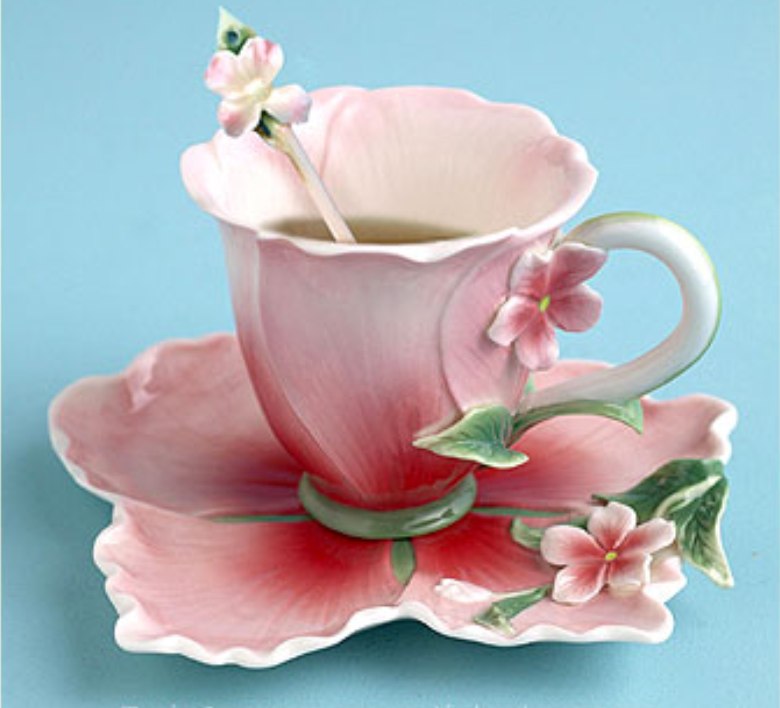
The porcelain tea cup of today.

I smile at the thought of today and of pink porcelain cups.

by D. G. V.

*** Author’s Note: this link leads to a poem I wrote for my daughter Amy.

The Joy of the Lord

But now I come to You, and these things I speak in the world, that they may have My joy fulfilled in themselves.” John 17:14

Jesus Christ was a man of sorrows, and yet he often spoke of joy. He knew of joy, because he steadfastly possessed it, in spite of everything he had to suffer and endure.  A joy that can face the cross, man’s betrayal, and the apparent desertion of those whom he trusted.   And he desired for this joy to be fulfilled in our lives.

The joy of the Lord is not of this world;  it is not boisterous;  it is a holy joy that manifests itself within us, something that can be experienced from the very depths of our being. We cannot create this joy ourselves; it is a fruit that the Holy Spirit produces in us.

This joy is independent of the world and external circumstances.  It is said that in the middle of a storm, there is a central place of utter calm.  In the same way, while on earth, the Lord always stood in that place of tranquility in spite of all the tumult that surrounded him. Christ’s joy is a fortress that no outward force can penetrate or destroy.

Let us consider some practical ways we can cultivate this joy, this fruit of the Spirit.

The first thing we can do is to avoid focusing on our own feelings, but rather practice the art of meditation. This is the secret of joy: we reflect upon the Lord, Who He is, and what He has done for us;  we ruminate upon His Word and promises. The more we seek the face of God, the greater our assurance of His love and of our salvation, and the richer our experience of this joy will be.

Next, we need to avoid everything that will break our fellowship with God, for the moment this is broken, we become miserable.  We must do our best to avoid sin and refrain from looking to the world for happiness.

Most of all, we behold the things that Christ spoke of, the truths that He made manifest while on earth, and contemplate and dwell upon them.

“These things I speak in the world, that they may have My joy fulfilled in themselves.”

The Lord prayed to the Father, and spoke about the joy He wanted to impart to us.  Indeed how marvelous it is to know that it is possible for Christ’s joy to be fulfilled in us, and thereby glorify Him in our lives on earth!

** Related Post that describes the elements of joy : https://liliessparrowsandgrass.com/2012/01/04/elements-of-joy/

** Reference:  Martyn Lloyd-Jones, “Safe in the World: The Assurance of Our Salvation”, Crossway Books,
Illinois, 1988, pp. 106-118.

** Photography by David Gois

The Sorrow of Forsaking Christ

Then Jesus, looking at him, loved him, and said to him, “One thing you lack: Go your way, sell whatever you have and give to the poor, and you will have treasure in heaven; and come, take up the cross, and follow Me.”  But he was sad at this word, and went away sorrowful, for he had great possessions.” Mark 10:21-22

Can great worldly possessions cause sorrow?  A wealthy young ruler’s encounter with Christ left him grieving because of the choice he made.

At the outset, he came running to Jesus, knelt by Him, and asked what he must do to inherit eternal life.  Here was a man who seemed to possess everything in life: he was noble and excellent, and yet he felt that something was missing. There was this concept of eternal life which gave him a curious desire to attain.  He sensed the urgency. He came running.

He asked the right question, but when Jesus gave him the answer, he walked away.  Why did he give up his pursuit of eternal life?

He expected Christ to confirm his own preconceived notions about the Kingdom of God. The Lord demolished his understanding.  Attaining eternal life is not simply a matter of following God’s commandments; it demanded something else. Christ probed into the very depths and center of his being and exposed his real dilemma: his trust in riches, his pride and confidence in them.

”Give it away”, says Christ, “and let me decide.”  The kingdom of God must be entered Christ’s way. It is a radical transformation, the way of the cross, of following in Christ’s footsteps.

He did not like Christ’s answer. He walked away, deciding to hold on to his possessions and the life he was accustomed to. But in leaving, he was sorrowful. A deep heaviness engulfed him as he opted for worldly riches over eternal life, as he walked away from Christ.

Judas turned his back on Christ and was filled with such remorse and sorrow that he took his own life.  To abandon Christ is spiritual suicide, to turn away from eternal life, from the only one who can give true riches, happiness, joy and peace.

Oh do not walk away from Christ! If you leave Him, you will have left your last and only hope, and nothing else remains but grief and eternal unhappiness. Run towards Him, embrace Him, and never let Him go.

*** Reference: Martyn Lloyd-Jones, “The Kingdom of God”, Crossway Books, Wheaton, Illinois, 2010, pp. 155-172.

*** Photography: After Sunset by Andrew Koksharov