
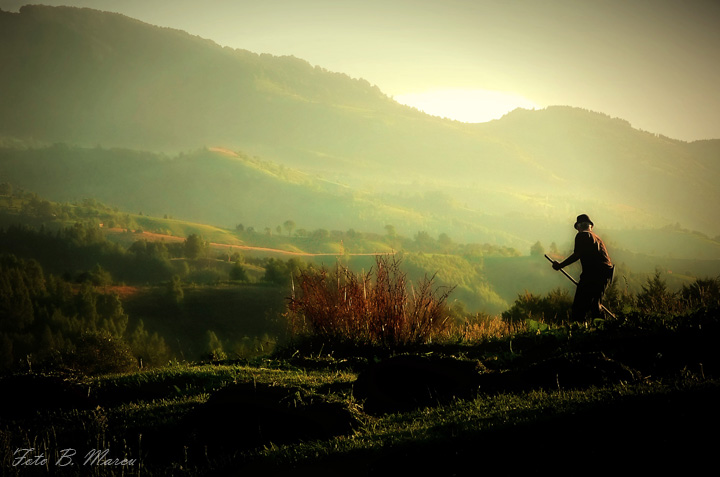
“The Precious Possession”

7 dimineata

“A lazy man does not roast his prey, but the precious possession of a man is diligence.” Proverbs 12:27,  NASB

There is a certain possession that the Bible esteems as valuable, something to be desired.  It is not a material treasure; it cannot be bought with worldly currency.  That precious possession is diligence.

The best way I can expound upon this scripture is to share how I have witnessed this trait in the way my parents lived. To this day, they continue to amaze me beyond words.   I don’t ever remember seeing them idle or wasting time.   When I was growing up, I recall both of them going to work early in the morning each day.   As both of them are lawyers, they had plenty of things to occupy them, but they somehow managed to come home and eat three meals with their children almost every day.

When my father was home, I remember that he would either be reading or writing.  My mother incessantly tended to projects that she would follow through to completion.  They were compassionate people, reaching out to help the poor and underprivileged.  I remember many times when we children would have to sit squeezed shoulder-to-shoulder at the dinner table because some poor folks were invited to dine with us.

My father is now in his eighties, but he still goes to work every day:  he serves the people as the oldest member of Congress in an Asian country.  Surrounded with books and so many documents to read and review,  he always carries a pen,  a small pad of paper, or a book to read.  My mother is in her late seventies, and yes, she also works at her office each day.  A long time ago, when I was a little child, she started a cooperative to help and encourage poor people to save their money and to free them from the grasp of greedy usurers.  What she set into motion decades ago has now grown by leaps and bounds — from a small group of less than 20 people, and now currently reaching almost a hundred thousand members.

Diligence involves perseverance, persistence, and tenacity.  It is not achieved overnight, but grows through the days and through the years as it is applied.  It is honoring one’s Creator with making the best use of one’s time and talents, and like the cooperative that my mother once started, through daily application, grows exponentially in value.  Diligence eventually becomes a person’s precious possession where moths cannot corrupt, nor can thieves break through and steal.


“Rock, Sand, and Storms”

Rock, Sand, and Storms

Oftentimes what lies beneath is fundamental, for it determines the final outcome of the visible structure standing on top of  it.  I think of the roots that support the life of plants and trees; I think of the foundation that undergirds the construction of houses and buildings.

Jesus tells a story of two men who built two houses, one upon the rock, and the other upon the sand. One man was wise, the other was foolish. If the teaching we draw from this story is that the difference between these two men and two houses is revealed when the storms of trials come, the lesson would have little value, for it would have been too late to do anything about it.

But Christ’s purpose in telling the story is to enable us to detect the fundamental differences between two principles of living, so that we may be able to safeguard ourselves against the consequences of a false grounding, while there is still time. Hence, the decisions and actions enacted at the very beginning are crucial to eventual outcomes.  It is said that at the outset, the wise man dug deep before building his house, whereas the foolish man did not take the trouble to lay a foundation.

Let us consider the particular outlook of the man who built his house upon the sand:  (1)

First, he was impatient, in a hurry, compelled to take short cuts to achieve quick results.

Second, because he was impatient, he did not take time to listen to instruction, in this case, to the principles involved in constructing a house. He considered it unnecessary, and deemed his ideas better than established methods.

Third, he possessed a mentality of not thinking things through, of not considering possibilities and eventualities.  He wanted a beautiful house in a particular location, and put it up quickly on the sand, without considering the environmental hazards that could topple the house down.

Indeed when the winds and the rains and the floods came, the house built upon the rock stood firm, but the house upon the sand fell, and great was its fall.

Note that this story does not stand by itself:  it is sobering to recognize that Christ relates it to how people handle his teachings.  A house can be thought of as one’s life structure, and all of its related external outgrowths.  Christ claims that putting his teachings into practice is like digging deep and building a sure foundation to enable us to withstand the storms of life.

And Christ likens one who simply hears his words and does not do them, to the man who built his house upon the sand, with a stern prediction of a great fall, when the storms of life arrive.

Scripture Reference:

“Therefore whoever hears these sayings of Mine, and does them, I will liken him to a wise man who built his house on the rock:  and the rain descended, the floods came, and the winds blew and beat on that house; and it did not fall, for it was founded on the rock. “But everyone who hears these sayings of Mine, and does not do them, will be like a foolish man who built his house on the sand: and the rain descended, the floods came, and the winds blew and beat on that house; and it fell. And great was its fall.” Matthew 7:24-27, New King James Version

***(1) Reference on the characteristics of the foolish man:  Martyn Lloyd Jones, Studies in the Sermon on the Mount, Connecticut, Martino Publishing, 2011, pp. 298-299

***Photography by Dmitri Moronov

“Porcelain Morning”


Porcelain Morning

Kinder still the porcelain morning:
kaolin clay
baked in the kiln of the evening
sun,   cleansed
of the dross of darkness,
translucent resonance,
impermeable
white.

Pink peonies await
and the glossy leaves —
choose your colors,
paint
with care.

by D. G. Vachal © 2013

*** image by TTor

The Precious Possession

7 dimineata

“A lazy man does not roast his prey, but the precious possession of a man is diligence.” Proverbs 12:27,  NASB

There is a certain possession that the Bible esteems as valuable, something to be desired.  It is not a material treasure; it cannot be bought with worldly currency.  That precious possession is diligence.

The best way I can expound upon this scripture is to share how I have witnessed this trait from my parents. To this day, they continue to amaze me beyond words.   I don’t ever remember seeing them idle or wasting time.   When I was growing up, I recall both of them going to work early in the morning each day.   As both of them are lawyers, they had plenty of things to occupy them; however, they somehow managed to come home and eat three meals with their children almost every day.

When my father was home, I remember that he would either be reading or writing.  My mother incessantly tended to projects that she would follow through to completion.  They were compassionate people, reaching out to help the poor and underprivileged.  I remember many times when we children would have to sit squeezed shoulder-to-shoulder at the dinner table because some poor folks were invited to dine with us.

My father is now in his eighties, but he still goes to work every day:  he serves the people as the oldest member of Congress in a Southeast Asian country.  Surrounded with books and so many documents to read and review,  he always carries a pen,  a small pad of paper, or a book to read.  My mother is in her late seventies, and yes, she also goes to work each day.  A long time ago, when I was a little child, she started a cooperative to help and encourage poor people to save their money and to free them from the grasp of greedy usurers.  What she set into motion decades ago has now grown by leaps and bounds — from a membership of less than 20, and at present, to almost a hundred thousand — one of the biggest cooperatives in a Southeast Asian country.

Diligence involves perseverance, persistence, and tenacity.  It is not achieved overnight, but grows through the days and through the years as it is applied.  It is honoring one’s Creator with making the best use of one’s time and talents, and like the cooperative that my mother once started, through daily application, grows exponentially in value.  Diligence eventually becomes a person’s precious possession where moths cannot corrupt, nor can thieves break through and steal.

House Upon the Sand

 26And every one that heareth these sayings of mine, and doeth them not, shall be likened unto a foolish man, which built his house upon the sand:

 27And the rain descended, and the floods came, and the winds blew, and beat upon that house; and it fell: and great was the fall of it.
 Matthew 6:26-27

The imagery of the “house upon a rock” has dominated my mindset every time I read passages of the Sermon on the Mount. It seemed as if the following two verses in Matthew 7 just faded silently into the background. What a victorious and happy outcome for a house to go through the beating winds, floods and rains, and still be standing, unscathed after the onslaught of attacking storms.

But as I read on again, this time, beyond glossing over, the enormity of the remaining words of the chapter sweeps me away in a giant tidal wave as I vicariously feel the tremors of the house upon the sand.

Consider the concluding remarks of the Sermon on the Mount.  According to Jesus, there are only two types of people: the wise and the foolish.  One either belongs to one group or the other. There are no “in-betweens”. The wise are those who hear the sayings of Jesus and put them into practice.  But wait, there are those who also hear His sayings, but Jesus calls them foolish. What makes them foolish? They simply hear the words of Jesus, but do not act upon them. They may be those who agree with the truth of His sayings and listen wholeheartedly.  But they may also be those who have heard of Jesus and His words, but dismiss them outright, so of course they would not apply His teachings to their very own lives.

“These sayings of Mine”, what are they?  In particular, and in the current context, they can immediately be linked to the Beatitudes and what Jesus said in His Sermon on the Mount.  In general, since Jesus is “The Word” (John 1:1), “These sayings of Mine” can be associated with God’s Word, the Bible.

The wise have a fortunate result after digging hard into the rock, a difficult place as it requires tremendous effort to construct a house upon it, but storms leave the house standing.

The foolish have a devastating outcome after building their house upon the sand.  Consider the looseness of this ground, the ease with which construction materials can be quickly set upon it.  A house is one’s  structure, a dwelling place, a place of belonging.

The shifting sand has no foundation.  There is no anchor of Truth found in it, unlike the solid Rock.  The sayings of Jesus were heard, but not put into practice. How profound that it is not enough to listen to God’s Word. How fearful it is to dismiss, reject, or neglect His Words.  Jesus says that when the storms of life come, and they will come, anything built on top of this unreliable ground will be beaten severely by the winds and the rains and the floods. And the last words carry a stern warning: “And great was the fall of it.”

The great fall of one’s structure, one’s dwelling place, one’s place of belonging.  Think of it.  But here’s the good news:  being wise or being foolish is a choice.


MyFreeCopyright.com Registered & Protected