
Setting the Lord Always Before Us

“I have set the Lord always before me: because He is at my right hand, I shall not be moved.” Psalm 16:8 KJV

King David revealed one of the great secrets of his life, what kept him going in the midst of great adversities and tragic events: that he set the Lord always before him, being constantly aware of God’s nearness and presence. And we can say that this was also true of the Lord Jesus Christ, who lived a life of constant prayer and communion with the Father.

Let us consider what might be components of this significant guiding principle in life.

The first aspect is a determination, an act of the will, and a definite decision to practice this guideline.  We live busy lives in a world where “life seems to be organized for us”.  It is alarming how the years pass by so swiftly, and we often wonder if we have accomplished what we purposed to do.  We must insist, therefore, to take control of our lives and live it according to what we believe are the right paths, because if we do not, our lives will be governed by the tyranny of external events, the pressures of business, meetings, and day-to-day living, and we ultimately forget the needs of our immortal soul.

The second aspect of this practice is the art of recollection, speaking to ourselves and reminding ourselves of God and our relationship to Him.  Upon waking, we consciously dismiss thoughts of doubts and temptations and deliberately remind ourselves that we are children of God and heirs of eternity. And we meditate upon the implications and outcomes of belonging to God.

These components involve the action of diligently seeking the presence of God, to know that He is not simply a philosophical concept: He is a Person, and we can come before Him, speak and fellowship with Him.

One practical way we can attain this is to spend time reading the Bible, where God reveals Himself to us, and the more we read God’s Word, the more we are made aware of His Presence.  It must not be fitful, but rather a regular and systematic daily reading, to go through the book from Genesis to Revelation year by year. And we need to spend time in prayer, talking and listening to God.

These are the ways we set the Lord before us, and we must do it always, through trials and triumphs, through storms and calm, always.  And like King David, we shall not be moved, whatever befalls,  because the Lord is at our right hand.

Reference: David Martyn Lloyd-Jones Ssermon: Set the Lord Always Before Me

Photograph: Great Bear Lake by LCT

How Faith Overcomes

“ For whoever is born of God overcomes the world: and this is the victory that overcomes the world, even our faith.” I John 5:4

Faith is the victory that overcomes: what an astounding tautology put forth by the Apostle John! Certainly a lofty concept, but let us consider how our faith in Christ makes overcoming the world a practical and actual possibility.

First, believing that Jesus Christ is indeed the Son of God gives us the capacity to rest upon the power and ability of Christ, the One who conquered death and is alive forevermore.

“The name of the Lord is a strong tower; the righteous run into it and are safe” 1 Just as men of old ran to the tower to seek safety from their enemies, in the simplicity of our faith, we run to Christ, use His powerful name, hide in Him in a literal sense for protection, defense, and deliverance. We rely utterly upon Him. This is what is called “the great strategy of faith”, the assurance of the possibility that is open to us, that we can go to Christ directly, immediately, and simply look to Him and rest in Him. And when the battle rages on and we feel that we are at the point of falling, we simply cry “Jesus”, and believe and know that He is at hand to deliver and protect us.  As little children, we do not look at the enemy, but simply rely upon Him.  Victory is in Him, in His power, and not in ourselves.

Second, we use faith in an active sense.  We deliberate upon the Christian gospel and ponder what faith in Christ really means in terms of this fight we face against the world, the flesh and the devil.  We consider Jesus Christ in relation to this battle: that He took upon the likeness of sinful flesh because of the power of Satan, of sin and of evil, that He came because He is the only way by which we could be delivered from these overpowering forces. And in His life, death and resurrection, Christ overcame these powers.

As we see ourselves belonging to Christ, we realize that we share in His victory and everything that belongs to Him. Our whole perspective towards this fight changes: because Christ has overcome the world, and because we are in Him, then we have overcome.  In a practical sense, being in Christ enables us to see that we can literally draw strength and power from Him and from His fullness; we have inexhaustible resources behind us, we have a source of supply that can never fail. There is absolutely no limit to the power of Christ.

And in our human frailty, when we sin and fall back, there is forgiveness in Christ. There is nothing that so enables us to overcome as this deliverance from our sins and failures, the freedom from that overwhelming sense of despair, so we can arise again and continue our journey through life.

Lastly, faith enables us to behold the ultimate glory and perfection that await us.  Our hearts are encouraged though the fight may seem arduous and endless.  Faith makes us realize that Christ, who died for us and sustains us in this world, will one day present us faultless before the presence of God with exceeding joy.

And this is the victory that overcomes the world, even our faith.

*** 1  Proverbs 18:10

***Reference:  Martyn Lloyd Jones, Life In Christ, Crossway Books, Wheaton Illinois, 2002, pp. 604-613.

*** Photo: Elie Tower by Dimitri


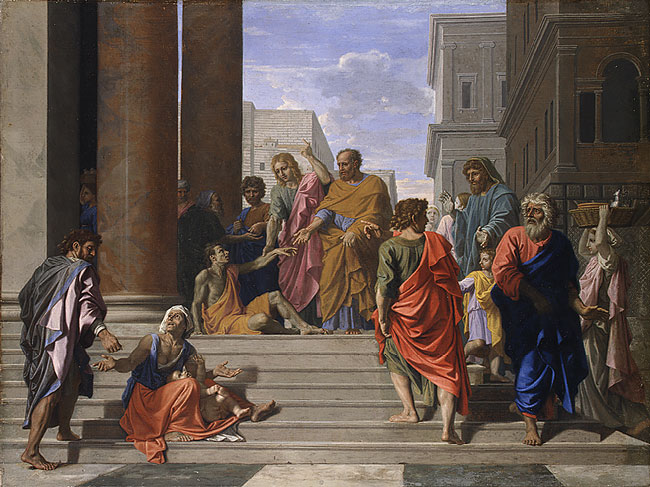
At the Gate Beautiful: A Parable of Purpose

Then Peter said, Silver and gold have I none; but such as I have give I thee: In the name of Jesus Christ of Nazareth rise up and walk.” Acts 3:6

Reflecting upon the healing of the lame man at the Gate Beautiful, one can infer a parable that illustrates the purpose and function of the Christian Church.

Here was a man lame from birth, carried daily to the temple so he could ask for alms. His paralysis is a metaphor of the biblical view of the condition of mankind: we are born in sin, lost, and crippled in our ability to conquer the devil, temptation, and sin solely by our own strength.

The world is unable to address the problem of sin. All it can do is to give “alms”. We can turn to entertainment, art, literature, music, philosophy, and science, but these only give temporary relief, a momentary escape from our problems.

Just as the lame man was expecting “alms” from Peter and John, mankind often expects the wrong things from the Church, stemming from erroneous notions about its message and function.  People expect moral advice, philosophical teaching, or perhaps psychological treatment. At times, they expect the Church to give political pronouncements on what needs to be done in terms of social issues.

But Peter declares the primary and essential purpose of the Church in a resounding and memorable phrase:  “Silver and gold have I none; but such as I have I give you: in the name of Jesus Christ of Nazareth rise up and walk.”

Silver and gold have I none. The business of the Church is not to “give alms”, but to deal with the real problem of man, to be here for one thing: man’s soul. Here is the call, the commission for which the Church is sent: not to be a cultural, psychological, political or social entity, but that which is concerned about the very center of man’s life and his problem:  the dilemma of the paralysis in his soul, that which incapacitates him and sends him astray — his estrangement from God, his ignorance of God.

In response to the man’s need, Peter deliberately points to Jesus, the carpenter of Nazareth, who is the Christ, the Messiah in the flesh: the One who has the power to heal man’s disabled soul, to give him a new life, to reconcile him to God.

What the lame man received through Peter surpassed all his expectations.  He expected alms, but instead the bones of his once lifeless feet and ankles received strength. He became a man now able to live a fully functional life.

What a person receives from Christ is not temporary relief, but a cure. The Lord cures our guilt from past sins because He gives us absolute forgiveness through His shed blood on the cross.  He gives us an abundant life through the new birth. A fresh beginning.

As we walk with Christ and discover the power and unspeakable joy that He offers us in this new life, surely we cannot help but go through our days on earth leaping and praising God!


*** Reference:  Martyn Lloyd-Jones Sermon: Healing of the Lame Man at the Gate Beautiful

*** Painting: by Nicolas Poussin, 1655  (French, 1594-1665), http://www.metmuseum.org

The Attributes of Love

“Beloved, let us love one another, for love is of God; and everyone who loves is born of God and knows God.” I John 4:7

As children of God, we are commanded to love one another. If it were simply a matter of liking one another, then our obedience would easily be fulfilled. The commandment to love, however, is more difficult to accomplish.

What is the difference between liking and loving a person?

The two concepts are not degrees of the same thing. To like somebody is something instinctive and elemental; it does not necessitate effort; it comes naturally and is dependent to a large degree upon the physical senses and outward appearances.

The word “love” has sadly been debased and misused in modern parlance, often being associated with infatuation. But love is something that must be thought of in terms of God, because the Bible tells us that God is love.

Love is a highly intelligent process. In contrast to liking somebody, love is not driven by instinct or natural responses, but operates at a higher level. It is determined to go beyond the superficial, infiltrating the inner person, to dig into something deeper and of more value. Love overcomes obstacles and excuses, overlooks the superficial unattractiveness, in order to behold the person behind the imperfections.

We employ our mental faculties, as an act of the will, to love even the people we do not like; we treat them as if we do like them, and choose to act with kindness towards them in spite of our natural feelings.  It is an act of obedience.

And yet there is more to love.   As the apostle John asserts: “But whoever has the world’s goods, and sees his brother in need and closes his heart against him, how can the love of God abide in him?” I John 3:17

Love drives us out of our seat of theorizing and romanticism, to do something about easing the pain of our fellowman. By its very nature love must express itself, not in words, but in actions.

Such are the salient attributes of love, and the reason we are commanded to love one another is because love is of God. And love is the litmus test of our being born of God, of our knowing God, and of our passing from death unto life.

** Reference: Martyn Lloyd-Jones, Life in Christ, Crossway:Wheaton, Illinois, 1982, pp. 357-366.

** Photograph: On Golden Pond by Artemis

The Sorrow of Forsaking Christ

Then Jesus, looking at him, loved him, and said to him, “One thing you lack: Go your way, sell whatever you have and give to the poor, and you will have treasure in heaven; and come, take up the cross, and follow Me.”  But he was sad at this word, and went away sorrowful, for he had great possessions.” Mark 10:21-22

Can great worldly possessions cause sorrow?  A wealthy young ruler’s encounter with Christ left him grieving because of the choice he made.

At the outset, he came running to Jesus, knelt by Him, and asked what he must do to inherit eternal life.  Here was a man who seemed to possess everything in life: he was noble and excellent, and yet he felt that something was missing. There was this concept of eternal life which gave him a curious desire to attain.  He sensed the urgency. He came running.

He asked the right question, but when Jesus gave him the answer, he walked away.  Why did he give up his pursuit of eternal life?

He expected Christ to confirm his own preconceived notions about the Kingdom of God. The Lord demolished his understanding.  Attaining eternal life is not simply a matter of following God’s commandments; it demanded something else. Christ probed into the very depths and center of his being and exposed his real dilemma: his trust in riches, his pride and confidence in them.

”Give it away”, says Christ, “and let me decide.”  The kingdom of God must be entered Christ’s way. It is a radical transformation, the way of the cross, of following in Christ’s footsteps.

He did not like Christ’s answer. He walked away, deciding to hold on to his possessions and the life he was accustomed to. But in leaving, he was sorrowful. A deep heaviness engulfed him as he opted for worldly riches over eternal life, as he walked away from Christ.

Judas turned his back on Christ and was filled with such remorse and sorrow that he took his own life.  To abandon Christ is spiritual suicide, to turn away from eternal life, from the only one who can give true riches, happiness, joy and peace.

Oh do not walk away from Christ! If you leave Him, you will have left your last and only hope, and nothing else remains but grief and eternal unhappiness. Run towards Him, embrace Him, and never let Him go.

*** Reference: Martyn Lloyd-Jones, “The Kingdom of God”, Crossway Books, Wheaton, Illinois, 2010, pp. 155-172.

*** Photography: After Sunset by Andrew Koksharov