
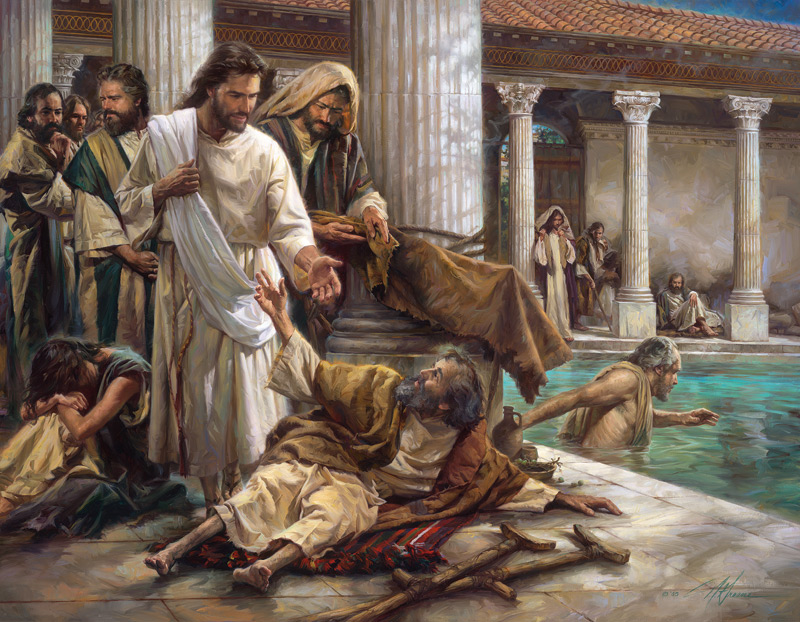
Is Christ The One Or Shall We Look for Another?


“Are you the one who is to come, or shall we look for another?”  Matthew 11:3

 Of the most vital and central importance in our earthly existence is our concept of who Jesus Christ is. When John the Baptist sent his followers directly to Christ to confront him about who he was, they in fact asked a crucial and pivotal question: “Are you the Savior of the world, or shall we look for another?”

In spite of his physical and mental depression while he was in prison, John the Baptist did the right thing when he told his disciples to go at once to Jesus, to ask and see for themselves. In the same manner, we can go to the Gospels and consider Jesus Christ, his words, his miracles, his death on the cross, his resurrection from the dead, to see for ourselves whether we find our answer in Him, or keep on searching.  And as we read the Bible, let us analyze and discover whether we come to recognize, as Martin Luther did, that “Christ is the key to Scripture”, that “everything must be understood in relation to Christ” (1).

 The message of the gospel is the person of Jesus Christ Himself, and the astounding claim that He is the Son of God who came into this world and dwelt among us, and that there is “no other name under heaven given among men whereby we must be saved.” (Acts 4:12).

“He is central, he is first, and if we are wrong about him, it does not make any difference, even if we are right everywhere else.” (2)

Part of the difficulties we confront about the person of Jesus Christ are aspects which cannot be understood in terms of abstract or philosophical reasoning.  And if what the Bible tells us about him is true, then it transcends human intellect and comprehension.  It comes to us as a revelation, an announcement of good news in a world beset with problems, sin, misery and death.

Hence, instead of trying to grasp, reason out and span the “infinities and the immensities” about what and who Christ is, let us be guided by what John the Baptist advised his followers: just go to Him, confront Him and learn about the many aspects to His nature and character as portrayed in each of the Gospels. We look at Him in the Bible, speak to Him in prayer, and consider the testimonies of other Christians.  And when we do this, it may well be that we shall arrive at the same conclusion that many others in a similar quest have come before us:

They have considered Jesus and made the decision to look to no other: Jesus Christ is the incomparable One, the Son of God, the Savior and Light of the World, the Way, the Truth and the Life.

Footnotes:
(1) Lectures on Romans in vol. 25 of Luther’s Works (1515; ET Concordia, 1972); Gloss on Rom. 1:5 (p.4)
(2) Martyn Lloyd-Jones, The Heart of the Gospel, Crossway Books, Wheaton, Illinois, 1991, p. 13

References:
Martyn Lloyd-Jones, The Heart of the Gospel, Crossway Books, Wheaton, Illinois,1991, pp. 11-25
John Stott, The Incomparable Christ, Intervarsity Press, Downer’s Grove, Illinois, pp. 15-42

*** Image courtesy of firepress

Not from Gibbons, but in the Image of God

“And God said, Let us make man in our image, after our likeness: and let them have dominion over the fish of the sea, and over the fowl of the air, and over the cattle, and over all the earth, and over every creeping thing that creepeth upon the earth.” Genesis 1:27

“Inaccuracies in a science textbook come from two primary sources. The first is human error.  Authors, editors, and illustrators occasionally make mistakes. Fortunately, such mistakes are rare.”  (1)

I stared at irony in the face.

I was dumbfounded as I thumbed through my daughter’s Biology textbook, particularly when I recognized the book’s foundation from which the study of life on this planet is based upon: a random force of evolution that somehow brings about the order and the wondrous intricacies of all forms of life.

The theory professes that man emerged as a result of primate evolution based on the concept of a molecular clock of time and DNA sequences in a mitochondrial gene. Along this timeline emerged the species of siamang gibbons, orangutans, gorillas, and chimpanzees, whereupon man came into existence as a result of random changes that emerged in the genome. (2)

Random changes that emerged in the genome.  How is it, then, that out of all the gazillion random changes among all forms of life, only the homo sapiens species is controlling the planet’s resources and transforming the world through its intelligence?

Contrary to the man-made theory that molecules are the origin of life, the Bible states that God created man in His own image.  Everything starts with God, the first cause, the Creator of the universe.  Let us consider this concept of God’s image in the human species.

Jonathan Edwards describes two main elements of this divine image concept. “The natural image consists very much in that by which God in His creation distinguished man from the beasts, namely, in those faculties and principles of nature whereby he is capable of moral agency.”  The “spiritual and moral image, consisted in that moral excellence with which man at the beginning was endowed” by God.  (3)

What are the capacities that make us like God and unlike ordinary beasts?

John Stott distills these faculties into five distinct characteristics:  “Firstly, we human beings are rational and self-conscious.  Secondly, we are moral, having a conscience that urges us to do what we perceive to be right.  Thirdly, we are creative, like our Creator, able to appreciate what is beautiful to the ear and the eye.  Fourthly, we are social, able to establish with one another authentic relationships of love.  For God is love, and by making us in His own image, He has given us the capacity to love Him and others.  Fifthly, we have a spiritual faculty that makes us hunger after God.  Thus we are uniquely able to think and to choose, to create, to love, and to worship.” (4)

Being made in God’s image breaks the shackles, the chain of evolution theory, that pigeonholes human beings into the taxonomies of the animal kingdom.  And as God’s image-bearers, we recognize that the sanctity of human life is irrefutable, its value, beyond measure.

by D. G. V.

References:

(1) Brooker, Widmaier, Graham and Stiling, “Biology”, McGraw-Hill Higher Education, 2008, p. vii
(2) Ibid. p. 548
(3) Jonathan Edwards, (1703-1758), Works of Jonathan Edwards, Volume 1, Hendrickson Publishers, 1998
(4) John Stott, Through the Bible Through the Year”, Baker Books, 2006, p. 18.

*** Photography:  Fisherman by Jose Miguel Rodriguez

How the Christian Glorifies Christ


“… and I am glorified in them.”  John 17:10

As God sent His Son into the world to glorify Him, we who believe in the Son are given the sublime privilege and responsibility to glorify Christ in our lives.  How do we accomplish this? Let us consider the progression of ways wherein we glorify our Lord.

First, we do so by believing in Him. The Pharisees did not believe in Christ. They dismissed Him as just a “Carpenter from Nazareth”,  the son of Joseph and Mary.  And the world to this day does not know Who Christ is and hence they disregard  Him.  To acknowledge Jesus Christ as the incarnate Son of God Who came into this world is to give Him glory.

Second, it is to apprehend why He came and what He has done while He lived on earth.  It is to be persuaded that the Lord Jesus Christ is God’s only way of salvation, that through Him we are brought back into right standing with God, into joyful fellowship with the Father.

Third, to glorify Christ is to know the meaning of the cross: that by Christ’s death and resurrection, our sins are forgiven and we become children of God.  And because of what Christ has done, He is everything to us.  We put an end to our self-reliance and realize that what we have become as a result of His sacrifice is entirely by the grace of God.

Fourth, it follows that we glorify Christ by telling other people about Him, pointing them to His Person, proclaiming Him as the Son of God, and His great sacrifice to free us from the bondage of our sins.  The world delights in lauding and talking about people: sports heroes,  politicians, actors, and other interesting personalities.  The Christian is one who delights in talking about Christ and praising Him.

Fifth, we glorify Christ by being living proofs of His life in us.  We are to be such men and women that the moment others meet us, they think about Christ.  People took note of the apostles when they performed miracles and spoke in a manner inconsistent with the speech of ignorant fishermen: they came to the conclusion that the apostles had been with Jesus.  The test of the Christian is that he or she cannot be explained apart from Christ,  and by this, Christ is glorified.

Finally, we glorify Christ by being the manifestation of His power, having been separated from the world. It is only by the power of Christ that we can leave the mentality of the world, and we become different.  The Christian is a person who strikes others as somebody who is distinct, somebody peculiar, not possessing the self-pride and self-assertion that the world applauds as strength; one who belongs to the lowly and humble Christ.  And he is spiritually alive, interested in spiritual things, making the affairs of the soul the top priority in his life and thinking.

As Christians we have been given a new life and a new understanding, a new outlook upon everything that faces us.  To the extent that we reflect this to the outside world, we glorify the Lord.

What a privilege and a great responsibility it is to be given this high calling, that Christ should be glorified in our lives.

*** Reference:  Martyn Lloyd-Jones, “Safe in the World: The Assurance of Our Salvation”, Crossway Books, Illinois, 1988, pp. 79-92.

*** Photography by Artemis

Where Love Dwells

Where Love Dwells

“And Jacob served seven years for Rachel: and they seemed unto him but a few days, for the love he had to her.”  Genesis 29:20

Love dwells in eternal habitations,
where seasons form
as the dew from heaven
upon the grass —

In quiet abodes
where burdens are weightless
as scattered feathers
afloat
between the branches —

Where the waiting
is not waiting
and the silence is palpable
as the song
of apple blossoms.

by  D. G. Vachal © 2012

Setting the Lord Always Before Us

“I have set the Lord always before me: because He is at my right hand, I shall not be moved.” Psalm 16:8 KJV

King David revealed one of the great secrets of his life, what kept him going in the midst of great adversities and tragic events: that he set the Lord always before him, being constantly aware of God’s nearness and presence. And we can say that this was also true of the Lord Jesus Christ, who lived a life of constant prayer and communion with the Father.

Let us consider what might be components of this significant guiding principle in life.

The first aspect is a determination, an act of the will, and a definite decision to practice this guideline.  We live busy lives in a world where “life seems to be organized for us”.  It is alarming how the years pass by so swiftly, and we often wonder if we have accomplished what we purposed to do.  We must insist, therefore, to take control of our lives and live it according to what we believe are the right paths, because if we do not, our lives will be governed by the tyranny of external events, the pressures of business, meetings, and day-to-day living, and we ultimately forget the needs of our immortal soul.

The second aspect of this practice is the art of recollection, speaking to ourselves and reminding ourselves of God and our relationship to Him.  Upon waking, we consciously dismiss thoughts of doubts and temptations and deliberately remind ourselves that we are children of God and heirs of eternity. And we meditate upon the implications and outcomes of belonging to God.

These components involve the action of diligently seeking the presence of God, to know that He is not simply a philosophical concept: He is a Person, and we can come before Him, speak and fellowship with Him.

One practical way we can attain this is to spend time reading the Bible, where God reveals Himself to us, and the more we read God’s Word, the more we are made aware of His Presence.  It must not be fitful, but rather a regular and systematic daily reading, to go through the book from Genesis to Revelation year by year. And we need to spend time in prayer, talking and listening to God.

These are the ways we set the Lord before us, and we must do it always, through trials and triumphs, through storms and calm, always.  And like King David, we shall not be moved, whatever befalls,  because the Lord is at our right hand.

Reference: David Martyn Lloyd-Jones Ssermon: Set the Lord Always Before Me

Photograph: Great Bear Lake by LCT