
Tag: love
“The Riches of the Poor”

The Riches of the Poor
In the midst of their calamity, they managed to smile. There was an unexplainable calm and peace upon their faces as they fell patiently in line, awaiting their turn to receive water, rice and canned goods. There was no noise, no panic, nor distress.
They had little to start with, and the little they had, they lost. They lived in palm-roofed huts that were blown away, and now they huddle under tents of tarpaulin held up by wooden planks. When the rains revisit at night, the fathers and mothers sit in the rain, while their little ones sleep under the sparse canopies. Help has been slow to arrive. Meek as sheep, they do not grumble. They wait.
A woman who stepped on a nail while braving the typhoon, walked many miles under scorching heat to where relief goods were distributed. Her foot throbbed with pain as she approached my daughter and me, and she held out her parasol to shield us from the sun. Other women joined us and offered their parasols as well. They told us they had little to eat, and when the relief supplies run out, they will share what remains with each other. Their sun-parched, emaciated faces somehow reflected an inner joy.
At that moment, I recognized the palpable wealth of the poor: they who possess little do not own the onerous burden of the “cares of this world, the deceitfulness of riches, and the lusts of other things entering in” 1. I felt the light-hearted freedom in their hearts, the natural sensitivity to gravitate towards gratitude, as the flowers of the field blossom, facing the sun.
As the nail that pierced the woman with the parasol, so has her countenance, along with the many other tranquil faces around her, wounded and scarred my heart forever, that noonday under the sun.
“Listen, my beloved brothers, has not God chosen those who are poor in the world to be rich in faith and heirs of the kingdom, which He has promised to those who love Him?” James 2:5 ESV
D. G. Vachal © 2013
1 Mark 4:19
*** Photography courtesy of Amy Lynn Vachal
“A Lion In Autumn”

A Lion In Autumn
Autumn and the reddening leaves
bask in the glow of an Indian summer sun,
I run through the wind in cambric
playtime clothes,
laughter explodes upon my face,
there is a warmth,
an amber warmth that lingers
in this momentary breath
of treasured hours —
I trace the furrows upon his face,
watch infinite shades
of a tangerine sunset
as I listen to stories of the times
when the olive groves were heavy
with fruit,
the songs of lemon blossoms
plenteous as raindrops
upon the dark green leaves —
Now the lion that prowled
through emerald forests
walks in slow, ordered steps,
protruding bones define the sagging,
golden fur,
he holds my arm,
I walk with him,
he and I
no longer swept
in the quick-footed dance
of my elusive childhood —
Time stands still,
palpable as the immutable truth
that luminescent stars sparkle
eternal in the heavens,
and the warmth that lingers
on this jasmine-white day
burns like a candle,
an obstinate flame that glows
eternal in my heart,
no matter the winter,
no matter the cold.
by D. G. Vachal © 2013
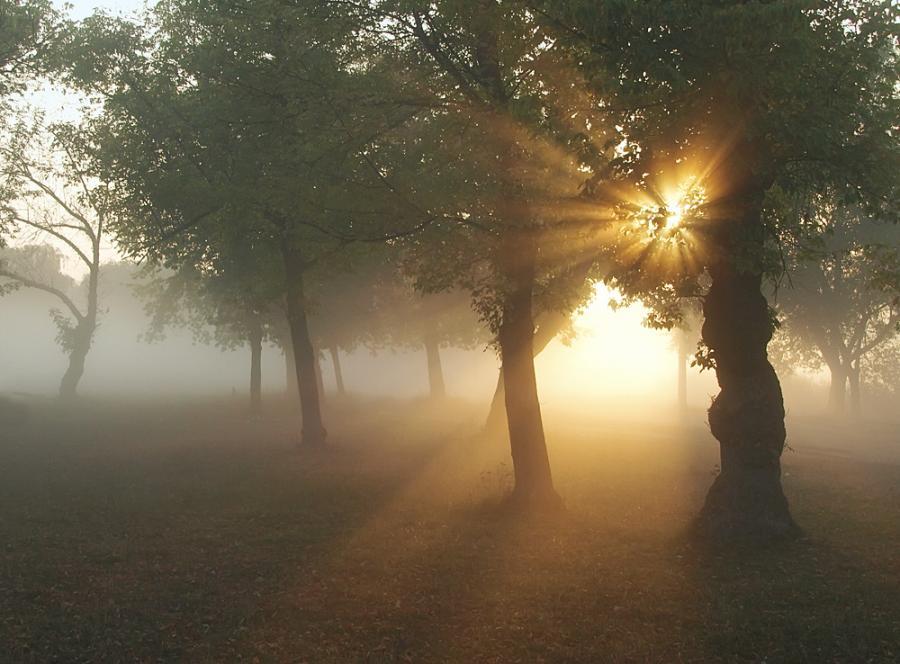
*** Image: Autumn by Denizler
“Twilight and White Linen”
Twilight and White Linen
Here we are and time
forsaken
when I found you —
latitudes of faces,
provinces
of eyelids and shoulders,
verdant archipelago
sculptured in sapphire
oceans,
the orbital fruit dangles,
suspended
from its ripening —
Twilight and white linen
stoke the hunger —
I slice zucchini
into cylinders,
slender wedges,
peppers into strips
of scarlet,
toss the cuttings
into volcanic oils of olive,
aromatic sesame —
the meat is warm
for the tasting,
pearls of rice turn amber
from the fragrant
spices —
here we are
and time.
by D. G. Vachal © 2013
*** Image by Rob Espierre
“Love’s Justice”

Love’s Justice
Is love inconsistent with justice in our human interactions? At times we hear the words “tough love” uttered by parents who wish to instill in their children some important life lesson, and often there is a struggle in determining a clear set of determining principles as to how this process is to be carried out.
Jesus tells a story about a father and his two sons. One son was dutiful and stayed home to work for his father. The other was rebellious: he demanded his inheritance upfront, went to a far country, and spent all his resources on riotous living. When his money ran out, and he recognized the error of his ways, he repented and journeyed back home, hoping he would find work as one of his father’s servants.
But instead of giving a scathing rebuke for all that the wayward son had done, the father adorned his son with the best robe, put a ring on his finger, and sandals for his feet. Then he ordered the fatted calf to be killed, and a feast prepared. The dutiful son was terribly upset at his father’s actions towards his long-lost brother. He refused to join in the feast and stayed outside in the darkness of his own creation — the darkness of a harsh spirit and a lack of love for his sibling.
A strange story perhaps, for there was no logical and expected justice served to the wayward son, but a total reversal of expected outcomes: the obedient son is standing outside in darkness, while the rebellious son is reveling inside the house, feasting with his father.
What then, becomes of justice in this story? Jesus gives the assurance that Love is the only real justice, for the main purpose of justice is not punishment, but reclamation. A justice that is truly enlightened is less concerned with the punishment of wrong than its reparation.
Had the father issued a harsh verdict against the prodigal son, coldly dismissing him, he would have been unjust to his son’s future potential, and thus would have sinned a more grievous sin against his own son. The worst sinner in the story was the son who did everything right, and yet acted in a vile, censorious, loveless way towards his brother.
One who does not love cannot be just.
God is Love, and God’s forgiveness is God’s justice, for if we acknowledge the error of our ways, and head back home to Him, He is faithful and just to forgive us our shortcomings, and to restore us into fellowship with Him, our Heavenly Father, through His Son Jesus Christ.
References:
* William J. Dawson, “The Empire of Love”, New York: Fleming H. Revell Company, 1907, pp 33-44.
* Luke 15: 11-32, King James Version
 lilies, sparrows and grass
You must be logged in to post a comment.